-
Title
-
Understanding and supporting neurodiverse girls in mainstream schools
-
Author
-
Milner, V. L., Mohamed, L., & Happ, F
-
Year Published
-
2025
-
Description
-
“Beyond the stereotype”: Neurodivergent students’ experience and peer and teacher understanding of neurodiversity in a mainstream girls’ school. Neurodiversity , 3. https://doi.org/10.1177/27546330251326056
Overview
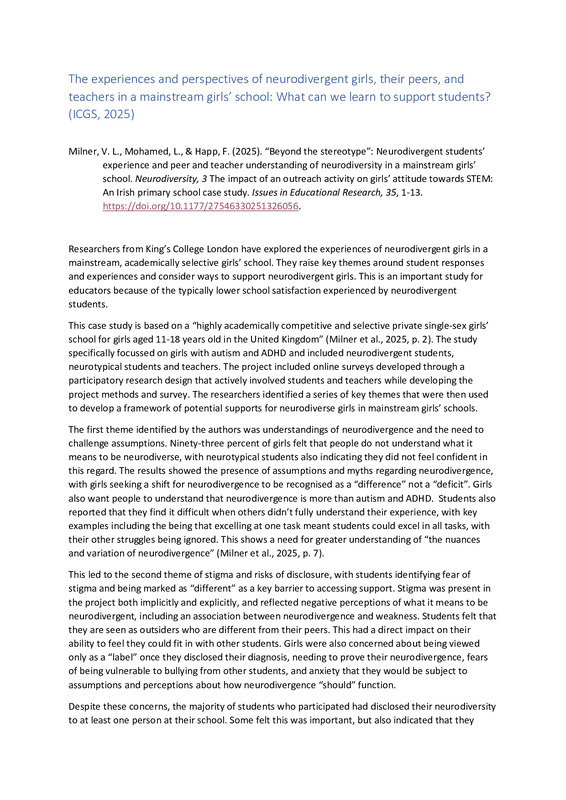
Researchers from King’s College London studied the experiences of neurodivergent girls (primarily those with autism and ADHD) in a selective all-girls’ school. Their findings shed light on how schools can better support these students.
Key Findings
Misunderstanding & Assumptions
- 93% of students said people don’t understand what it means to be neurodiverse.
- Common myths: excelling in one area = excelling in all areas; autism/ADHD are the only forms of neurodivergence.
Stigma & Disclosure
- Students feared being labeled, stereotyped, or bullied if they disclosed a diagnosis.
- Teachers viewed disclosure as essential for adapting instruction, but worried about bias or misinterpretation.
Camouflaging & Pressure
- Many girls described “performing” to fit in—masking differences at high emotional cost, leading to exhaustion and stress.
The Double Empathy Problem
- Neurodivergent students felt misunderstood.
- Teachers and peers lacked confidence in their understanding.
- This mutual gap deepened stigma and isolation.
Implications for Schools
- Whole-School Education: Incorporate assemblies or lessons to reduce stigma and myths.
- Safe Spaces & Trusted Staff: Provide quiet areas and support networks for overwhelmed students.
- Inclusive Teaching: Use clear instructions, adapt communication, and show patience with different learning needs.
- Amplify Student Voices: Involve neurodiverse girls directly in shaping strategies. - Universal Supports: Offer strategies for all students, including high-achieving but unidentified girls with neurodivergent traits.
-
Tags
-
neurodiversity
-
Type
-
Research Report
-
Research Category
-
Diversity & Inclusion
-
Learning
-
Single Sex Education
-
Teaching
-
Upper Grades (ages 14-18)
-
Middle Grades (ages 11-14)
-
Year of Study
-
2025
-
Identifier
-
46475