
Middle Grades (Ages 11-14)
- Title
- Middle Grades (Ages 11-14)
Items
-
 “If it’s Tuesday, it Must be Group Work!”: Steps to Confident Collaborative Culture CreationDr. Ralph Covino (2024) 2024Rooted in the scholarly literature on the importance of joy, the value of play, and the benefits of deliberate practice in facilitating student learning, this report explores how elements of a school’s successful modern dance company’s program, including regular rehearsal and experiential group learning, were ported to a middle school Humanities classroom. The action research project reported here examines how the implementation of iterative discussion and collaborative work patterns shifted girls’ attitudes and approaches to group work in a Seventh Grade Ancient Civilizations class, transforming them from being grade-focused to centered on the quality of the group’s projects instead. Through an analysis of survey data, classroom observations, and student reflections, the study concludes that explicitly teaching discussion skills, coupled with regular collaborative practice, improves confidence in girls in group settings, reduces grade anxiety, and fosters the creation of community through hands-on learning in a supportive and enriching learning environment.
 -
 “Not Too Formal”: Strategies to Support Grade 6 English Students to Strengthen Collaboration and Relationship SkillsLiz Joyce 2022There is a commonly held belief that girls avoid confrontation and engagement in “hard” conversations with peers. In this action research project, I set out to challenge this assumption, while also looking to understand what communication strategies and relationship skills the students already had and regularly employed. This research was conducted over the course of approximately eight weeks in late Fall 2021, with 10 Grade 6 students in their English class of which I was not the assigned teacher. By focusing on how teaching specific strategies impacts the abilities to strengthen collaboration and relationship skills, lessons were designed and implemented to target self-awareness and interpersonal communication skills. Students were taught strategies that enabled them to communicate more directly with peers as well as challenge their own thoughts and perceptions. Student feedback was regularly solicited in the form of surveys, writing prompts, class discussions, and a focus group midway through the project. The students’ feedback was critical to the process as it guided and molded the presentation of lessons as well as the format of the last classes. Findings from this project reinforce the importance of creating a safe and supportive environment for girls to share their thoughts and feelings. Overall, girls need to feel a connection with materials and security in their relationships to give meaningful feedback, engage in deeper discussions, and access their problem-solving prowess.
 -
 2023-24 GARC Research SummaryICGS 2024A summary of the findings of the 23-24 GARC Cohort on Collaboration
 -
 Assessing the Impact of Aspects of School Life on Well-Being in Girls' Schools(2025) 2025Starting in the 2020-2021 academic year, a high-achieving school for girls in grades five through twelve partnered with Authentic Connections (AC) to build upon their longstanding commitment to balancing a high-achieving culture with a focus on well-being. The AC team used survey results to quantify mental health and identify focus areas; though there is still work to be done, student and staff well-being have improved.
 -
 Developing Agency and Leadership in Year 12 Peer Mentor Girls Through the Co-Designing and Implementation of a Social Media WorkshopLaurie Garland (2025) 2025Girls in the 21st Century often aspire to be leaders, and we need to help develop their agency and leadership skills in our education setting, to give them the tools and skills to continue into the future. At Wycombe High School, I recruited our new cohort of 20 peer mentors and met with them for 12 weeks. During this time, we discussed different themes each week to help develop the students’ leadership skills as they planned and created a social media workshop to deliver to a Year 7 class. During this process, I implemented a mixed-methods approach to collect data, including questionnaires, interviews, journals, and video recordings, and identified the themes through my analysis. The findings indicate that the peer mentors’ confidence increased when co-designing and delivering the social media workshops. The peer mentors had full autonomy and independence over the project, which strengthened their agency. The peer mentors also became more aware of their own social media practices, and the relationship between the different year groups developed, which created a sense of connectedness. The Year 12 students were able to develop a sense of agency, thereby providing them with the opportunity to strengthen their leadership skills. To further advance this study, it would be necessary to create additional opportunities within the school for peer mentors and other student leaders to exercise greater agency in their educational and school-related experiences. Listen to Laurie's podcast ( or find it on our streaming channel ): Your browser does not support the audio element.
 -
 Developing Self-Efficacy Through Collaboration: Building Math Confidence in Grade 6 Girls Through Academic Discussion SkillsDuncan Flaherty (2025) 2025This action research study examined the impact of academic discussion skills on developing discipline-specific self-efficacy in two Grade 6 girls’ math classes using the R.E.A.L.® discussion framework. This intervention addressed the gender confidence gap in mathematics learning, whereby girls report lower levels of math confidence than boys in their peer group (Zander et al., 2020). Research shows that cooperative learning is an effective tool for teaching mathematical problem-solving in a whole class context (Klang et al., 2021), and that combining scaffolding for discussion skills and math content can increase conceptual understanding (Kazak et al., 2015). I contended that math discussion skills provide a mechanism to increase math self-efficacy through their capacity to enable mastery experiences, vicarious experiences, social persuasion, and positive emotional states, which are the primary sources of self-efficacy (Bandura, 1997). A math-specific version of the R.E.A.L.® discussion framework, initially developed for use in humanities classes, was generated in a collaboration between R.E.A.L.® and me and piloted during the six-week action research period. The research was conducted at Nashoba Brooks School in Concord, Massachusetts, USA. The project began with a student orientation to the R.E.A.L.® discussion framework, where students learned the primary tools (relate, evidence, ask, and listen) they would use during discussions, as well as how to prepare notes for discussions and write post-discussion reflections. Collected data were primarily 2 qualitative in discussion question preparation notes, reflection notes, student journal entries, field note observations, and video recordings of discussions. Quantitative data were collected through Likert scale surveys administered throughout the intervention to measure self-reported math self-efficacy. Data were analyzed through organization, description, and interpretation using a coding process that grouped data into frequently recurring themes (Mertler, 2020). This action research study found that math-specific academic discussion skills using the R.E.A.L.® framework increased student confidence when discussing and understanding math material. Specifically, the R.E.A.L.® discussions generated evidence of growth in all four areas of self-efficacy development as outlined by Bandura (1997). The findings are significant for math educators and leaders in girls’ schools as they suggest that math-specific academic discussion skills are effective in closing the gender confidence gap in mathematics learning. Future practice should incorporate explicit teaching of discussion skills alongside other constructivist modes of instruction to maximize self-efficacy development opportunities in math classes.
 -
 Examining the impact of a project based learning approach to teaching French how does it encourage confidence and self efficacy in girls independent problem solvingJo Orgill (2021) 2021Over the course of 15 lessons from September to November 2021, I undertook a project-based learning (PBL) approach to teaching French with 15 Year 8 girls. They worked independently to produce a video tour of their school for our partner school in France. In a mixed-methods research design, I examined the impact of this student-centered approach to language learning on the girls’ self-efficacy, confidence, and independent problem-solving skills. The PBL approach resulted in high pupil engagement, increased self-efficacy over time, as well as enhanced attainment and ability to problem-solve independently. The results led me to reflect on the importance of collaboration for girls in my setting as well as my use of pupil voice in my practice. This study contributes to the literature on self-efficacy in language-learning, with a particular focus on the benefits of a PBL approach for girls.
 -
Increasing middle school girls’ critical engagement with AI through lightweight workshopsSolyst, J., Axon, A., Stewart, A. B., Eslami, M., & Ogan, A. (2023) 2023With the increasing presence of AI in society it is becoming vital that students understand how to use this technology safely and are aware of its potential benefits, uses, bias, and impact on ethics and privacy. AI is prevalent in everyday life, and girls are highly likely to be exposed to AI regardless of which post-school path they pursue. Researchers from Carnegie Mellon University in the USA have undertaken a project to gain a better understanding of middle school girls’ “perceptions and knowledge gaps about AI” (Solyst et al., 2023, p. 807). By developing a lightweight educational workshop (a workshop less than three hours long), the authors explored girls’ perceptions and approaches to AI with the aim of helping them avoid misinformation, provide them with useful learning materials and “lend insight into a more just future” (Solyst et al., 2023, p. 807). Currently, learning opportunities that are designed “to address children’s knowledge gaps in AI literacy” largely focus on the technical aspects of the technology. This excludes many of the ethical questions associated with AI (Solyst et al., 2023, p. 807). The researchers who developed this paper were also concerned about the limited understanding “of how girls perceive and learn about AI”, with a risk that this may “potentially [compound] existing inequities in AI representation” (Solyst et al., 2023, p. 807). This project explored a learner-centred education format to support middle school girls to fill their knowledge gaps around AI in a shorter workshop form. This is an important new contribution for educators as it provides an alternative to existing programmes that are more than three hours long, or are run as an intensive workshop session. The workshops were specifically targeted at middle school girls and assumed that participants had no prior computing or AI-related knowledge. They were focussed on “critical and creative thinking about AI systems and ethics, and supported learners in thinking about training data” (Solyst et al., 2023, p. 807). The workshops were also designed around an asset-based approach (rather than a deficit-based approach), and drew on girls’ prior “knowledge and interests as a base for further learning and engagement” (Solyst et al., 2023, p. 807). This is important because it has been shown to be a successful way to “support girls of diverse backgrounds in learning computing” (Solyst et al., 2023, p. 807). The researchers considered girls’ understandings and perceptions before, during and after the workshop through observations of the workshop session, surveys and interviews with participants. The workshop was run as a standalone module offered within an all-girls computing camp. Participants for the project were recruited via BoltGirls (a robotics-focused organisation in the east coast of the US) and AmazingGirls (a general girls organisation in the southwest of the US). The workshop ran for approximately 90 minutes, which included educational content and interactive activities. Workshop content was focussed on the concepts of bias, algorithms, and definitions of AI (including training data, power, and how AI can identify or misidentify content). During the interactive sections of the workshop, this was extended to consider how AI could be used to solve challenges in the girls’ own communities and a problem affecting the world more generally. This focussed on how AI could help solve the problem, but also risks of harm and how this could be mitigated. While the workshop was interactive, there was “less use of interactive tools” and a greater focus on “group discussions and ideation… as a means to understand opinions, perceptions, and knowledge gaps” (Solyst et al., 2023, p. 813). Many girls who participated were able to describe AI without technical details prior to completing the workshop. There was an improvement in technical awareness following participation, and a “more complex understanding of AI” compared to the pre-workshops surveys (Solyst et al., 2023, p. 810). The girls also showed an increase in ability to talk about AI, with a much more nuanced approach to intelligence and AI, and comparisons between artificial and human intelligence. This included the recognition of different types of knowledge and intelligence, understanding the role of “informational knowledge and facts”, and being able to recognise limitations in the capabilities of AI technology (Solyst et al., 2023, p. 810). The workshops discussed algorithmic bias, and girls were able to identify bias in the context of AI providing misinformation. This included concepts such as racism, and the ability to critically analyse content to discuss implications for society. Girls raised concerns about how AI uses data, especially in relation to privacy, although they did not always specifically link this to AI, and instead focussed on the risk of hacking when discussing chatbots and digital assistants. While some participants were able to identify t
-
Is it a Matter of Skills? High School Choices and the Gender Gap in STEMDalit Contini, Maria Laura Di Tommaso, Anna Maccagnan and Silvia Mendolia (2025) 2025This article investigates the extent to which gender differences in academic skills contribute to the gender gap in STEM (Science, Technology, Engineering, and Mathematics) high school tracks in Italy. Focusing on the critical educational transition at age 14, when Italian students select among various secondary school types, the study examines whether disparities in mathematics and language skills—where boys typically outperform in math and girls in language—account for the underrepresentation of girls in STEM-oriented schools. The findings reveal that while academic skills do influence school choice, they only partially explain the gender gap in STEM enrollment, particularly among students from higher socio-economic backgrounds. For students from less educated families, skill differences have minimal explanatory power regarding the gender disparity in STEM choices. The research suggests that factors beyond measurable academic abilities, such as societal norms, stereotypes, and possibly differences in self-confidence or interest, significantly influence the gendered patterns in educational pathways. The study emphasizes that simply addressing skill gaps may not suffice to close the gender divide in STEM fields. Instead, comprehensive strategies that also tackle cultural and psychological barriers are necessary to encourage more equitable participation in STEM education and, by extension, in related career fields. Key Finding: "Teacher grades and test scores strongly influence choices, but the impact of ability differs by gender. Girls are less likely to opt for STEM high schools unless they excel in mathematics or have a strong comparative advantage in the subject. Conversely, boys often choose STEM pathways regardless of weak math performance and continue to do so even when they excel in Italian. Consistent with prior research, our findings suggest that girls require stronger evidence of their mathematical ability than boys to pursue STEM studies."
-
 Making the Stumble Part of the Dance: Using Improvisational Gameplay to Empower Year 8 Girls to Courageously Collaborate in a Social Entrepreneurial ProgramSamanda Sankowsky (2024) 2024This action research project explored how 13 to 14 year-old girls engaged in improvisational gameplay activities to empower them to courageously collaborate in a social entrepreneurial program. The research was conducted with a group of 17 Year 8 students at an all-girls independent school in Perth, Western Australia. The project examined how in social entrepreneurial teams of four to five, girls participated in one 5-10-minute improvisational gameplay warm up each lesson that didactically explored and developed a “toolkit” of fundamental collaborative skills and processes. The research tracked the effectiveness of this toolkit when girls applied it to their collaborative social entrepreneurial project as their group pitched, designed, manufactured, and sold a market product that advocated for a local charity in support of a United Nations Sustainable Development Goal (SDG). Both qualitative and quantitative data including questionnaires, rating scales, interviews, observations, and student reflections were collected as the girls participated in and reflected upon the process over a 10-week period. The results indicate that the girls exhibited a greater sense of joy towards collaboration, and this allowed them to develop not only a better understanding of the skills associated with social entrepreneurship but inspired them to strive for personal growth in this role. The girls were taking collaborative risks more frequently with their peers and expressed that they were better equipped with the tools to embrace mistakes and transform them into innovative possibilities or solutions. All in all, throughout the development and application of their improvisational toolkit, the girls’ felt that their voices were projected with greater confidence and collective equity, both in their collaborative groups and in their role as a social entrepreneur in the broader school community.
 -
Plugging the gaps in the STEM pipeline: A reproducible, scalable model that supports middle school and undergraduate females studyingAkin, V., Santillan, S. T., & Valentino (2024) 2024Developing new and innovative ways to support girls in STEM is high on the agenda of girls’ schools globally. Researchers from Duke University have developed a reproducible model that targets two key periods when girls are more likely to leave STEM studies – middle school and tertiary undergraduate studies. They do this by focussing on helping girls develop their own STEM identity. This is crucial, because stereotypes about who should study STEM have been found to have a significant impact on girls being able to see themselves in STEM careers (International Coalition of Girls’ Schools [ICGS], 2024). This research represents a unique mentoring model that can be scaled up or down and replicated in girls’ schools to help support students as they seek to follow their STEM aspirations. Despite numerous interventions that have been developed to support female STEM engagement, there still exists a significant drop in girls’ participation in STEM during middle school and the undergraduate years of tertiary study (Akin et al., 2024, p. 452). This has been linked to a “clear shift in girls’ social identity relative to mathematics during middle school”, and a further decrease in female STEM enrolments after completing secondary school (Akin et al., 2024, p. 452). In particular, self-confidence in mathematics can have a significant impact on girls’ STEM identities more broadly. An interdisciplinary group of both researchers and STEM practitioners have developed a model called Improving Girls’ Math Identity (IGMI) to address these issues at both undergraduate college level and middle school. The IGMI programme involves the recruitment and training of undergraduate women studying STEM to become mentors and workshop leaders for local middle school girls. This serves a dual purpose of providing mentoring and workshop opportunities to adolescent girls, and also the creation of a network of female STEM undergraduate students. IGMI was designed to help undergraduate women and middle school girls develop a positive mathematics or STEM identity. This was intended to improve not only their beliefs and attitudes about STEM, but also “the degree to which they see themselves as members of the corresponding community” (Akin et al., 2024, p. 453). Undergraduate students were provided with the necessary training and materials to deliver workshops and mentoring to middle school girls. The research case study included this content as part of a broader curriculum, however, it can also be offered as an extra-curricular offering. IGMI was run successfully three times during this research, in both in-person and virtual formats (due to pandemic restrictions). The IGMI goals are achieved through three key approaches to support the development of a positive STEM identity. The first is the belief that the student is capable of completing the training necessary to be a STEM professional. The second is the belief that a STEM-related career is “personally relevant and meaningful to the student’s broader life goals” (Akin et al., 2024, p. 454). Finally, this connects with the belief that STEM fields, both educationally and professionally, have the capacity to be a welcoming environment – something that is also supported through the development of healthy, positive female STEM networks during the IGMI programme. Targeting these three areas responds to research showing that developing a positive mathematics or STEM identity is crucial to supporting girls who wish to pursue study in this field. (ICGS, 2024). IGMI also focusses on enhanced mathematical skills building. This includes metacognition, problem-based learning, and spatial reasoning. Developed as a scalable model that can be replicated in girls’ schools, the IGMI intervention provides benefits for both the middle school and undergraduate participants. Both middle school girls and women in undergraduate courses who participated in IGMI showed “improved mathematical self-efficacy and confidence” (Akin et al., 2024, p. 453). This was especially apparent in the presentation of mathematical work, problem-solving skills, and improved skills when approaching new problems. Beyond these skills, however, there also exists the development of a professional support network among undergraduate women, and a positive mentorship programme for middle school girls. Undergraduate women also gained an increased understanding of barriers to female participation in STEM, which in turn led participants to feel more empowered when navigating the STEM environment in their university studies and potential employment opportunities. It also led to improved confidence and leadership skills, and an increased desire from undergraduate women to maintain ongoing involvement in supporting adolescent girls on their own STEM journeys. This model represents an important opportunity for girls’ schools to bring together adolescent girls and undergraduate women who have a shared interest and desire to study STEM, while al
-
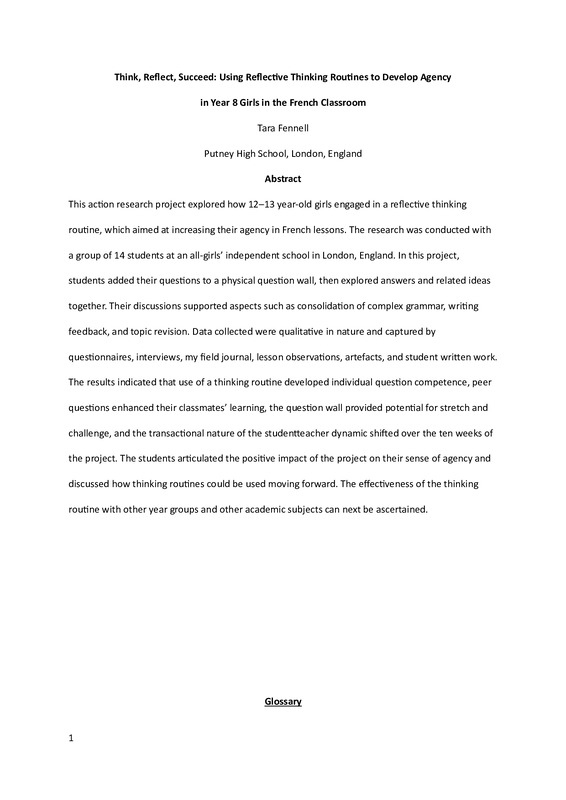 Think, Reflect, Succeed: Using Reflective Thinking Routines to Develop Agency in Year 8 Girls in the French ClassroomTara Fennell (2025) 2025This action research project explored how 12–13 year-old girls engaged in a reflective thinking routine, which aimed at increasing their agency in French lessons. The research was conducted with a group of 14 students at an all-girls independent school in London, England. In this project, students added their questions to a physical question wall, then explored answers and related ideas together. Their discussions supported aspects such as consolidation of complex grammar, writing feedback, and topic revision. Data collected were qualitative in nature and captured by questionnaires, interviews, my field journal, lesson observations, artefacts, and student written work. The results indicated that use of a thinking routine developed individual question competence, peer questions enhanced their classmates’ learning, the question wall provided potential for stretch and challenge, and the transactional nature of the student-teacher dynamic shifted over the ten weeks of the project. The students articulated the positive impact of the project on their sense of agency and discussed how thinking routines could be used moving forward. The effectiveness of the thinking routine with other year groups and other academic subjects can next be ascertained.
 -
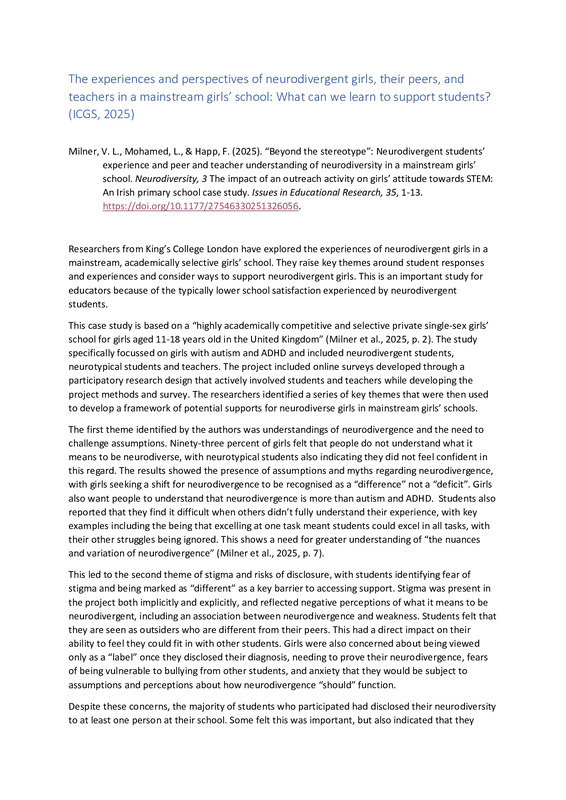 Understanding and supporting neurodiverse girls in mainstream schoolsMilner, V. L., Mohamed, L., & Happ, F 2025“Beyond the stereotype”: Neurodivergent students’ experience and peer and teacher understanding of neurodiversity in a mainstream girls’ school. Neurodiversity , 3. https://doi.org/10.1177/27546330251326056 Overview Researchers from King’s College London studied the experiences of neurodivergent girls (primarily those with autism and ADHD) in a selective all-girls’ school. Their findings shed light on how schools can better support these students. Key Findings Misunderstanding & Assumptions - 93% of students said people don’t understand what it means to be neurodiverse. - Common myths: excelling in one area = excelling in all areas; autism/ADHD are the only forms of neurodivergence. Stigma & Disclosure - Students feared being labeled, stereotyped, or bullied if they disclosed a diagnosis. - Teachers viewed disclosure as essential for adapting instruction, but worried about bias or misinterpretation. Camouflaging & Pressure - Many girls described “performing” to fit in—masking differences at high emotional cost, leading to exhaustion and stress. The Double Empathy Problem - Neurodivergent students felt misunderstood. - Teachers and peers lacked confidence in their understanding. - This mutual gap deepened stigma and isolation. Implications for Schools - Whole-School Education: Incorporate assemblies or lessons to reduce stigma and myths. - Safe Spaces & Trusted Staff: Provide quiet areas and support networks for overwhelmed students. - Inclusive Teaching: Use clear instructions, adapt communication, and show patience with different learning needs. - Amplify Student Voices: Involve neurodiverse girls directly in shaping strategies. - Universal Supports: Offer strategies for all students, including high-achieving but unidentified girls with neurodivergent traits.