
All-Girls Education and Learning
- Title
- All-Girls Education and Learning
Items
-
 Can STEM outreach activities help address gaps in the STEM pipeline? Exploring an Irish primary school case studyICGS 2025A new case study based on primary school girls’ attitudes towards STEM in Ireland takes important steps in considering ways to address disengagement and loss of interest in STEM. Researchers from the University of Limerick and University of Galway have developed this article to respond to the gap in the STEM “pipeline”, which has become a well-recognised source of a “lack of participation, progression, and achievement in STEM education for females” (Johnson et al., 2025, p. 221). Previous research based on these gaps and possible interventions have often focussed on “only one or two STEM disciplines” (Johnson et al., 2025, p. 221). This article goes further to consider all four disciplines through a case study of a STEM outreach activity and its impact on Irish primary school girls’ attitudes towards STEM (Johnson et al., 2025, p. 221). The article discusses “STEM outreach”, which is used to “classify activities that are delivered ‘outside of the traditional student/teacher relationship to STEM stakeholders (students, parents, teachers…) in order to support and increase the understanding, awareness and interest in STEM disciplines’” (Johnson et al., 2025, p. 224). This case study is based on the Spaceship earth project, a project run between the University of Galway, University of Limerick and the Irish meteorological service Met Éireann. The project engaged students in real-world, project-based experiments in the classroom with the intention of engaging and educating teachers, students and the public about STEM. Students developed their own experiments that involved “launching high-altitude balloons to the edge of space”, before analysing and reporting on their experiment (Johnson et al., 2025, pp. 224-225). It also included workshops for students where they could explore STEM project ideas. While multiple schools were initially involved in the project, due to withdrawal from various aspects of the research, the case study is based on one all-girls school located in the west of Ireland. Fifty-one students from the school participated in the study, all aged between nine and ten years. Due to pandemic restrictions at the time, some parts of the project were converted to run online, which included the workshops. The research also involved pre- and post-project surveys to better understand the impact of the outreach activity on girls’ attitudes. Before participating, the researchers observed that all girls had a positive attitude generally towards STEM. However, the age of the students in the study is consistent with the stage where this attitude has been shown to change. After participating in the project, there was no significant change in these attitudes. This was viewed as an “encouraging result” due to the presence of positive attitudes prior to participation, and continuation of these results, especially in light of a typical negative change at this point in time (Johnson et al., 2025, p. 230). Despite this outcome, the authors noted a particular concern regarding a decline in girls’ attitudes specifically towards science as a STEM discipline over the course of the study. This reflects some similarities to other research. While this outcome is not specific to this study, it highlights the need to consider specific STEM subjects, including attitudes and required interventions, in addition to STEM itself as a broader study area. While a relatively small study, these outcomes are important for schools and educators, as they show the potential benefits of a STEM outreach activity on girls’ attitudes towards STEM generally. This is especially worthy of consideration given that the girls who participated in this project retained their positive attitudes toward STEM at a time when research shows this typically declines. While the authors note that a larger-scale project could provide additional insight into this finding, this is a useful outcome for schools to consider when planning interventions for girls. Until further research is forthcoming, the authors additionally suggest that between the ages of ten and 14 these outcomes and attitudes are nonetheless monitored closely due to the risk factors of declining positivity towards STEM (Johnson et al., 2025, p. 229). The researchers also suggest that educators and school leaders consider how outreach activities intersect with the traditional school curriculum. Rather than assuming that each operates in isolation, this provides a space to consider how these different activities interact as part of a broader approach. A key challenge identified in the project is the specific decline in positive attitudes towards science , even as overall STEM attitudes remained stable. One way to address the decline in specific STEM subjects (rather than STEM overall) is to ensure learning is “more evenly distributed across each of the STEM disciplines” (Johnson et al., 2025, p. 231). This highlights a need to enhance girls’ proficiency in each subject in order to e
 -
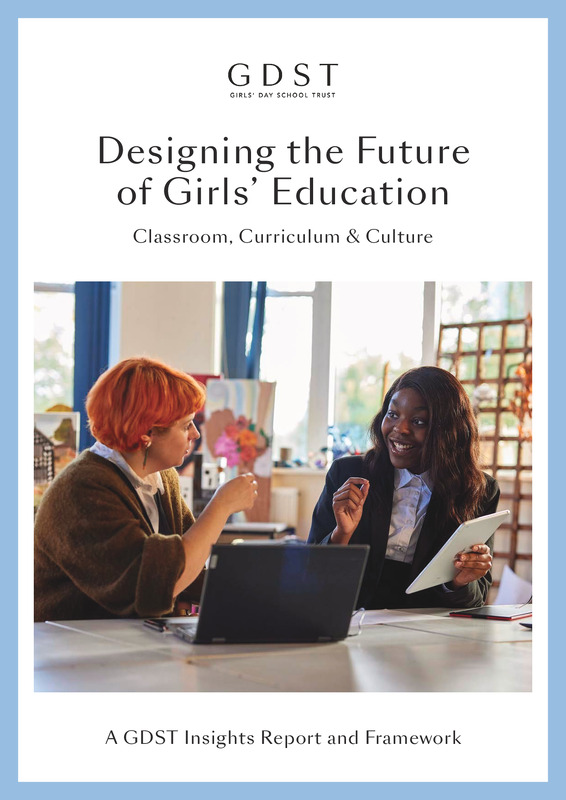 Designing the Future of Girls’ Education(2024) 2024Designing the Future of Girls’ Education , a GDST Insight Report and Framework, provides a critical resource to review any structural gender imbalances and stereotypes in the classroom, enabling the full potential of girls whatever school they attend. This report offers expertise and practical steps, in the form of a framework that will help shape and influence the education of girls. Through conversations with a range of contributors, we have focused on three core principles for educating girls— classroom practice, curriculum and (school) culture —that can be applied in almost every educational context to enable future female leaders to achieve their full potential, in whatever way they choose to define leadership and success. We hope the insights from academic experts, researchers, teachers, students, and campaigners will inspire reflections on how these principles can help girls cultivate the skills they need to lead happy and fulfilling lives.
 -
 Students’ perceptions of schools’ influence on the leadership self-efficacy of adolescent girls: religious and secular post-primary schools in IsraelPerets Shenhav , Davidovitch Nitza , Lewin Eyal (2025) 2025Overview This qualitative study explores how different school contexts shape adolescent girls’ confidence in their leadership abilities. Drawing on Social Cognitive Theory, the authors focus on three main pathways that influence leadership self-efficacy: mastery experiences, social modeling, and social persuasion . The research highlights how school structures, culture, and peer/teacher interactions can either limit or expand opportunities for girls to see themselves as capable leaders, with meaningful differences emerging between secular mixed-gender schools and religious all-girls schools. Key Findings Mastery Experiences: Girls in religious schools had more opportunities to practice leadership, both in school and through youth organizations. Social Modeling: Religious school students identified teachers, older peers, and guides as leadership role models; secular school students did not report strong models. Social Persuasion: Religious schools provided consistent encouragement from teachers, peers, and youth leaders, reinforcing girls’ leadership confidence. Secular school students reported little direct encouragement. Overall Impact: Religious all-girls schools fostered stronger leadership self-efficacy than secular mixed-gender schools by providing richer experiences, visible role models, and affirmational support. Implications for Girls’ Schools Structured opportunities for leadership and visible female role models are critical in developing leadership confidence among adolescent girls. Encouragement and affirmation from adults and peers can significantly influence students’ belief in their leadership capacity. The findings challenge assumptions that secular, coeducational settings are inherently more supportive of girls’ leadership development, highlighting the unique value of all-girls environments. Reference Perets, S., Davidovitch, N., & Lewin, E. (2025). "Students’ perceptions of schools’ influence on the leadership self-efficacy of adolescent girls: religious and secular post-primary schools in Israel." Frontiers in Psychology, 16. https://doi.org/10.3389/fpsyg.2025.1488270
 -
 The Latest PISA Report: Girls’ schools in Australasia continue to excel in providing academic, social and emotional benefits to girls(2024) 2024The latest PISA report has been analysed, and once again it shows that girls’ schools are providing a valuable environment where girls can reach their full potential and are supported academically, socially and emotionally. PISA (Programme for International Student Assessment) is a global study conducted by the Organisation for Economic Co-operation and Development (OECD). It is an important benchmark that evaluates the educational performance of 15-year-old students in 81 countries and provides an assessment of student abilities in reading, mathematics and science. This PISA assessment was delayed from 2021 to 2022 due to disruptions caused by the COVID-19 pandemic. Nonetheless, the results are valuable and give fantastic insight into the academic, social and emotional bene ts of girls' schools in Australasia – especially in light of the wellbeing challenges faced since the pandemic. In this brief, we share the insights from the PISA data.
 -
 The Positive Effects of the Girls’ School Environment: An Analysis of PISA Data2023This ICGS-commissioned study dives into the experiences of girls participating in the Programme for International Student Assessment (PISA). The report compared data from girls enrolled in coeducational schools and girls’ schools in 12 participating countries. Of the 60,144 respondents, 46,352 (75%) of the participating schools were coed, while 13,792 (23%) were girls’ schools. Findings trended overwhelmingly positive across a number of measures for those students attending girls’ schools, and the key differences are highlighted in this Executive Summary.
 -
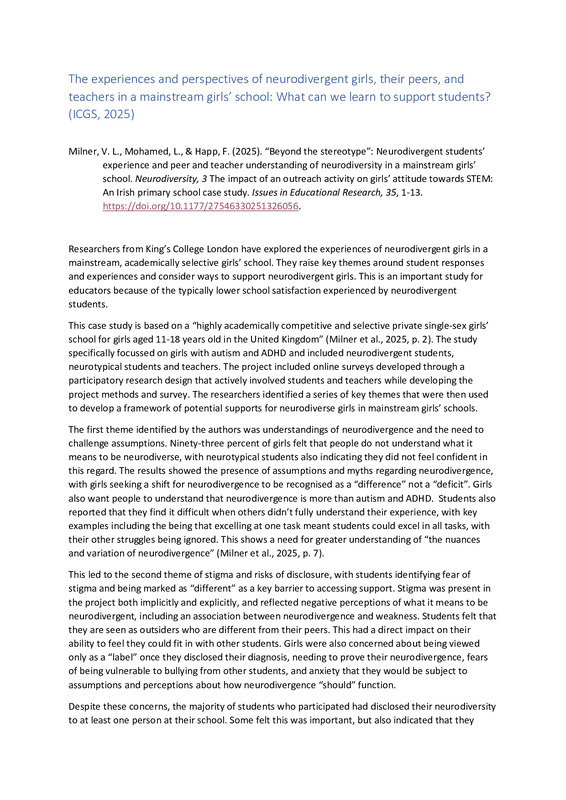 Understanding and supporting neurodiverse girls in mainstream schoolsMilner, V. L., Mohamed, L., & Happ, F 2025“Beyond the stereotype”: Neurodivergent students’ experience and peer and teacher understanding of neurodiversity in a mainstream girls’ school. Neurodiversity , 3. https://doi.org/10.1177/27546330251326056 Overview Researchers from King’s College London studied the experiences of neurodivergent girls (primarily those with autism and ADHD) in a selective all-girls’ school. Their findings shed light on how schools can better support these students. Key Findings Misunderstanding & Assumptions - 93% of students said people don’t understand what it means to be neurodiverse. - Common myths: excelling in one area = excelling in all areas; autism/ADHD are the only forms of neurodivergence. Stigma & Disclosure - Students feared being labeled, stereotyped, or bullied if they disclosed a diagnosis. - Teachers viewed disclosure as essential for adapting instruction, but worried about bias or misinterpretation. Camouflaging & Pressure - Many girls described “performing” to fit in—masking differences at high emotional cost, leading to exhaustion and stress. The Double Empathy Problem - Neurodivergent students felt misunderstood. - Teachers and peers lacked confidence in their understanding. - This mutual gap deepened stigma and isolation. Implications for Schools - Whole-School Education: Incorporate assemblies or lessons to reduce stigma and myths. - Safe Spaces & Trusted Staff: Provide quiet areas and support networks for overwhelmed students. - Inclusive Teaching: Use clear instructions, adapt communication, and show patience with different learning needs. - Amplify Student Voices: Involve neurodiverse girls directly in shaping strategies. - Universal Supports: Offer strategies for all students, including high-achieving but unidentified girls with neurodivergent traits.