-
Title
-
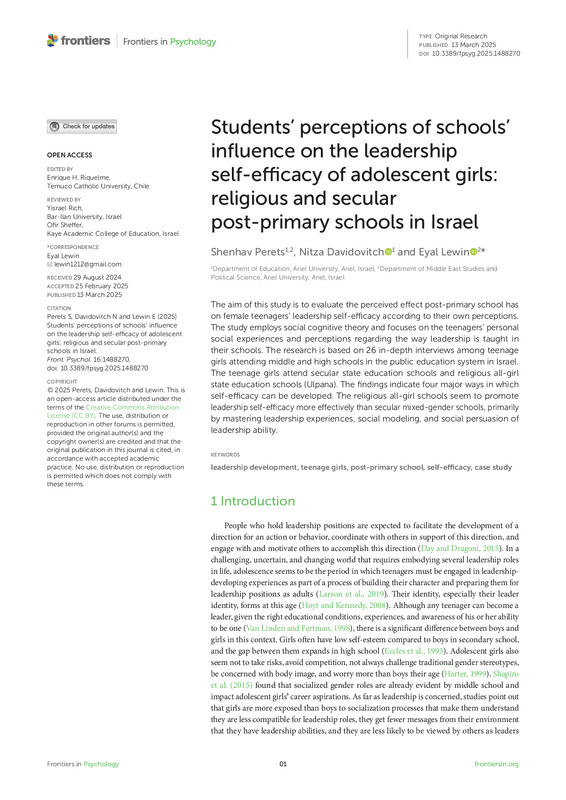
Students’ perceptions of schools’ influence on the leadership self-efficacy of adolescent girls: religious and secular post-primary schools in Israel
-
Author
-
Perets Shenhav , Davidovitch Nitza , Lewin Eyal (2025)
-
Year Published
-
2025
-
Description
-
Overview
This qualitative study explores how different school contexts shape adolescent girls’ confidence in their leadership abilities. Drawing on Social Cognitive Theory, the authors focus on three main pathways that influence leadership self-efficacy: mastery experiences, social modeling, and social persuasion . The research highlights how school structures, culture, and peer/teacher interactions can either limit or expand opportunities for girls to see themselves as capable leaders, with meaningful differences emerging between secular mixed-gender schools and religious all-girls schools.
Key Findings
Mastery Experiences: Girls in religious schools had more opportunities to practice leadership, both in school and through youth organizations.
Social Modeling: Religious school students identified teachers, older peers, and guides as leadership role models; secular school students did not report strong models.
Social Persuasion: Religious schools provided consistent encouragement from teachers, peers, and youth leaders, reinforcing girls’ leadership confidence. Secular school students reported little direct encouragement.
Overall Impact: Religious all-girls schools fostered stronger leadership self-efficacy than secular mixed-gender schools by providing richer experiences, visible role models, and affirmational support.
Implications for Girls’ Schools
Structured opportunities for leadership and visible female role models are critical in developing leadership confidence among adolescent girls.
Encouragement and affirmation from adults and peers can significantly influence students’ belief in their leadership capacity.
The findings challenge assumptions that secular, coeducational settings are inherently more supportive of girls’ leadership development, highlighting the unique value of all-girls environments.
Reference
Perets, S., Davidovitch, N., & Lewin, E. (2025). "Students’ perceptions of schools’ influence on the leadership self-efficacy of adolescent girls: religious and secular post-primary schools in Israel." Frontiers in Psychology, 16. https://doi.org/10.3389/fpsyg.2025.1488270
-
Tags
-
Girls & Leadership
-
Type
-
Research Report
-
Research Category
-
Single Sex Education
-
Upper Grades (ages 14-18)
-
Leadership
-
Year of Study
-
2025
-
External Link
-
https://www.frontiersin.org/journals/psychology/articles/10.3389/fpsyg.2025.1488270/full
-
Identifier
-
44382
-
Source
-
https://www.frontiersin.org/journals/psychology/articles/10.3389/fpsyg.2025.1488270/full