
Leadership
- Title
- Leadership
Items
-
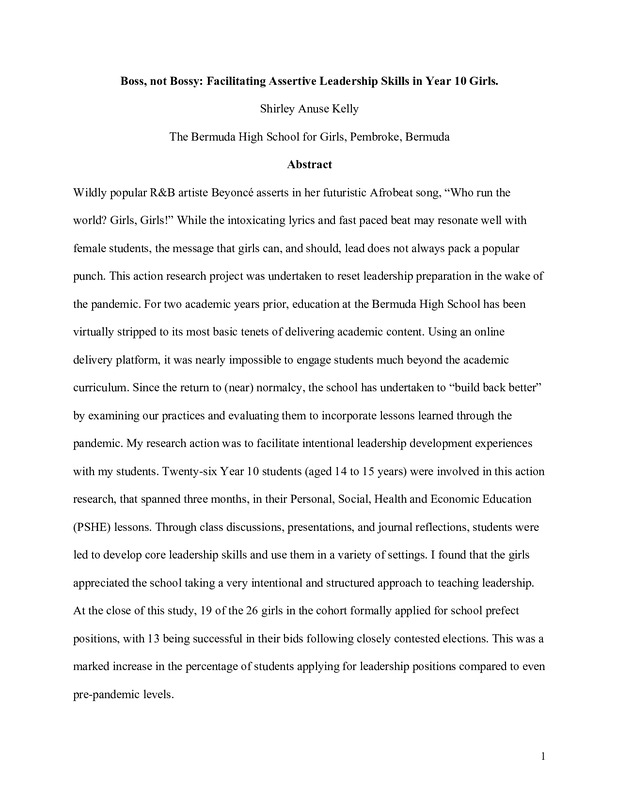 Boss, not-bossy: facilitating assertive leadership-skills in year 10 girlsShirley Anuse Kelly (2023) 2023Wildly popular R&B artiste Beyoncé asserts in her futuristic Afrobeat song, “Who run the world? Girls, Girls!” While the intoxicating lyrics and fast paced beat may resonate well with female students, the message that girls can, and should, lead does not always pack a popular punch. This action research project was undertaken to reset leadership preparation in the wake of the pandemic. For two academic years prior, education at the Bermuda High School has been virtually stripped to its most basic tenets of delivering academic content. Using an online delivery platform, it was nearly impossible to engage students much beyond the academic curriculum. Since the return to (near) normalcy, the school has undertaken to “build back better” by examining our practices and evaluating them to incorporate lessons learned through the pandemic. My research action was to facilitate intentional leadership development experiences with my students. Twenty-six Year 10 students (aged 14 to 15 years) were involved in this action research, that spanned three months, in their Personal, Social, Health and Economic Education (PSHE) lessons. Through class discussions, presentations, and journal reflections, students were led to develop core leadership skills and use them in a variety of settings. I found that the girls appreciated the school taking a very intentional and structured approach to teaching leadership. At the close of this study, 19 of the 26 girls in the cohort formally applied for school prefect positions, with 13 being successful in their bids following closely contested elections. This was a marked increase in the percentage of students applying for leadership positions compared to even pre-pandemic levels.
 -
Can a girls’ school environment change attitudes toward leadership ambitions?Lee & Sambanis (2023) 2023Recent research from scholars at the University of Pennsylvania has addressed the gender gap in “attitudes toward leadership and political participation” that exists “[a]cross countries” (Lee and Sambanis, 2023, p. i). This gap first begins to occur early in a girl’s life and can be influenced by behaviours and social activities observed at home or school. Lee and Sambanis (2023, p. i) use a case study from South Korea to consider if girls’ school environments can contribute to narrowing this gender gap by “increasing women’s civic and political participation and fostering their ambition for leadership”. This is an important topic of interest for girls’ school educators, as women are “underrepresented in key decision-making roles across almost all industries in the Australian workforce” (Workplace Gender Equality Agency, n.d.). It is critical that girls are supported to pursue their ambitions, and realise their potential. This is revealed in stark Australian statistics: 75 per cent of high school girls in Australia “believe they will ‘have every opportunity’ to become a leader when they grow up” (Lewis, 2020). Yet, by the time they leave school, this figure drops to 57 per cent (Lewis, 2020). Across many countries, there still exists gender inequality in areas such as “compensation, opportunities for professional advancement, and assessment of qualifications and performance” (Lee and Sambanis, 2023, p. 1). Australia is no exception (Australian Human Rights Commission, 2018; Workplace Gender Equality Agency, 2022). Research has long suggested that women are less interested than men in pursuing positions of leadership, however, this article explores these attitudes in more depth. This has allowed the authors to consider if a single-sex school environment has a beneficial impact on girls’ engagement and participation in positions of leadership, including political roles (Lee and Sambanis, 2023, p. 1). The authors focussed on south Korea as a case study because traditional gender values predominate in “economic and political spheres” across the nation (Lee and Sambanis, 2023, p. 1). The gender wage gap in South Korea is also one of the largest in OECD countries (Lee and Sambanis, 2023, p. 1). The researchers considered this topic via high school assessment items submitted in Seoul schools from 1974 to 2009. This content was then used to consider if education in a girls’ school environment had an impact on student engagement and subsequent ambition to work towards leadership goals and positions. Lee and Sambanis (2023) observed a clear pattern that showed students who attended girls’ schools were more likely to discuss opinions and interests in public life, were more likely to participate in political activities, and were also more likely to pursue leadership positions. Yet, this does not automatically equate to “a more feminist policy agenda” (Lee and Sambanis, 2023, p. 2). The educational opportunities provided by girls’ schools are therefore only one part of the solution to this gender gap, albeit a crucial one. The authors suggest that single-sex school environments are crucial because they consistently lead to four key factors in girls’ experiences: A greater likelihood of participation in political activities, engagement with political activism, interest and involvement in leadership roles, and less internalisation of gender stereotypes (Lee and Sambanis, 2023, pp. 3-4). These outcomes have practical implications for girls’ schools. Engagement can correlate with ambition, which can lead to active involvement. As the authors noted, this study showed a much higher level of political activity participation in girls attending single-sex schools (Lee and Sambanis, 2023, p. 6). The project also showed that women who had attended girls’ schools were more likely to have held a leadership position (Lee and Sambanis, 2023, p. 9). This is an important step in reducing the gender gap and allowing girls to explore their full interest and potential for leadership roles. This is also supported by girls’ attitudes at single-sex schools, where they were clearly “less supportive of traditional gender roles” (Lee and Sambanis, 2023, p. 11). Ultimately, the authors found that early interventions were essential to changing girls’ attitudes. These interventions could potentially have a cumulative effect, and once more women are visible in positions of leadership and change, this in turn may help inspire girls to reach their full potential regardless of societal attitudes (Lee and Sambanis, 2023, p. 13). The authors also noted that much more research is needed in this field. Until further research is undertaken, this provides useful information for girls’ schools that reinforces the value of learning in an all-female environment for young girls and adolescents. References Australian Human Rights Commission. (2018). Face the facts: Gender equality 2018 . https://humanrights.gov.au/our-work/education/face-facts-gender-equ
-
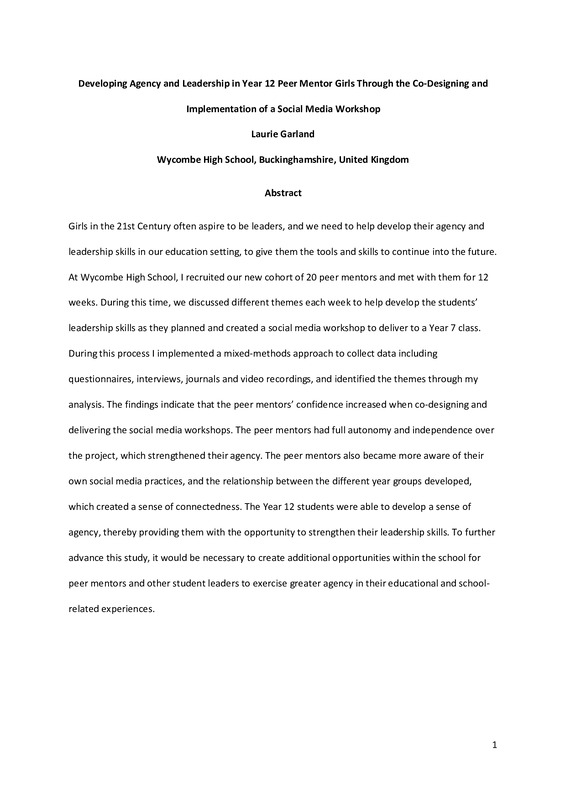 Developing Agency and Leadership in Year 12 Peer Mentor Girls Through the Co-Designing and Implementation of a Social Media WorkshopLaurie Garland (2025) 2025Girls in the 21st Century often aspire to be leaders, and we need to help develop their agency and leadership skills in our education setting, to give them the tools and skills to continue into the future. At Wycombe High School, I recruited our new cohort of 20 peer mentors and met with them for 12 weeks. During this time, we discussed different themes each week to help develop the students’ leadership skills as they planned and created a social media workshop to deliver to a Year 7 class. During this process, I implemented a mixed-methods approach to collect data, including questionnaires, interviews, journals, and video recordings, and identified the themes through my analysis. The findings indicate that the peer mentors’ confidence increased when co-designing and delivering the social media workshops. The peer mentors had full autonomy and independence over the project, which strengthened their agency. The peer mentors also became more aware of their own social media practices, and the relationship between the different year groups developed, which created a sense of connectedness. The Year 12 students were able to develop a sense of agency, thereby providing them with the opportunity to strengthen their leadership skills. To further advance this study, it would be necessary to create additional opportunities within the school for peer mentors and other student leaders to exercise greater agency in their educational and school-related experiences. Listen to Laurie's podcast ( or find it on our streaming channel ): Your browser does not support the audio element.
 -
Exploring positive leadership development strategies for adolescent girlsEva et al. 2021Most leaders experience their first exposure to “formal development training in adolescence” (Eva et al., 2021, p. 1). Despite many intervention programmes across many environments, a leadership gender gap still persists. In an effort to address this gap, researchers from Monash University, the University of Edinburgh and the University of Sydney have been considering research about adolescent girls’ leadership development. To date, this research has occurred across a range of disciplines and has become fragmented with a variety of theories and approaches. The authors have brought together a comprehensive review of 108 papers on this topic, published from 2000 to 2019. Through this review, they have identified five themes that “hold important implications for the leader development of adolescent girls” (Eva et al., 2021, p. 1). This is an important topic for educators in girls’ schools across Australasia. Many programmes exist to encourage leadership development in adolescent girls, yet the leadership gender gap persists in numerous industries. The outcomes of this research are important for educators as it brings together important perspectives on this topic that can influence how girls interact with leadership development opportunities at this crucial age. Adolescence is a “critical time to examine leader development” (Eva et al., 2021, p. 1) This is particularly important when considering how adolescent girls view “ who is a leader and what leadership looks like” (Eva et al., 2021, p. 1). The researchers consulted existing published literature and developed two advisory groups to give input into the project. Participants in these groups included board members from a secondary girls’ school and researchers from a range of fields. The project identified five broad themes about adolescent girls’ leader development: “(1) Leader emergency, motivation and identity; (2) Relationships with peers and adults; (3) Varieties of leader development opportunities; (4) Exercising agency in leader development programs; and (5) Integration of leader development into the school curriculum” (Eva et al., 2021, p. 4). Adolescent girls’ leader emergence, motivation, and identity was one of the “most prominent themes” observed. There was clearly an emphasis on conceptualising leader emergence as “a combination of self, other, and role attainment” (Eva et al., 2021, p. 4). The literature exhibited examples of single-sex educational environments where girls cited feelings of freedom from “gender-based leader stereotypes” (Eva et al., 2021, p. 6). Girls’ motivations to lead reflected a focus on affect, with girls perceiving leadership roles “as an opportunity to make meaningful change… rather than just doing (social normative) jobs for teachers” (Eva et al., 2021, p. 6). When girls see positive outcomes as a result of their leadership actions, they are also more likely to continue or seek leadership positions. Two key themes about leadership identity emerged during the project. The first suggested that girls view leadership as an inherently gendered role. The second instead suggested an absence of this stereotype, where leadership is instead viewed as a “relatively stable set of meanings associated with a particular role” (Eva et al., 2021, p. 6). This poses important considerations for girls who do not consider themselves to be “leadership material”, especially if they are facing barriers to their leadership aspirations. Interpersonal relationships can have a significant influence on girls’ leadership aspirations, especially if these relationships encourage gendered behavioural cues. The research surveyed showed that girls consider whether or not peers offer encouragement in relation to leadership roles, thereby showing the benefit of “positive relationships with each other” (Eva et al., 2021, p. 7). Other relationships of critical importance are those “between adolescent girls and adult figures such as teachers, parents, mentors and program leaders” (Eva et al., 2021, p. 7). In particular, relationships with a mentoring component have been shown to help “deconstruct gender stereotyping” through networking, mentoring, and opportunities to use their own voice and leadership skills (Eva et al., 2021, p. 7). This means mentors and educators must remain acutely aware of “implicit assumptions and gender bias regarding leadership” when engaging with adolescent girls (Eva et al., 2021, p. 7). A significant amount of research has been devoted to the range of leadership development opportunities available to girls. This includes opportunities where girls are required to combine multiple skills in their leadership positions, and those that are instead focussed on “a specific content area” (Eva et al., 2021, p. 8). The authors particularly observed that in some areas, participation alone is not sufficient for engender the development of leadership skills. Rather, these skills must still be “intentionally taught or learned” (Ev
-
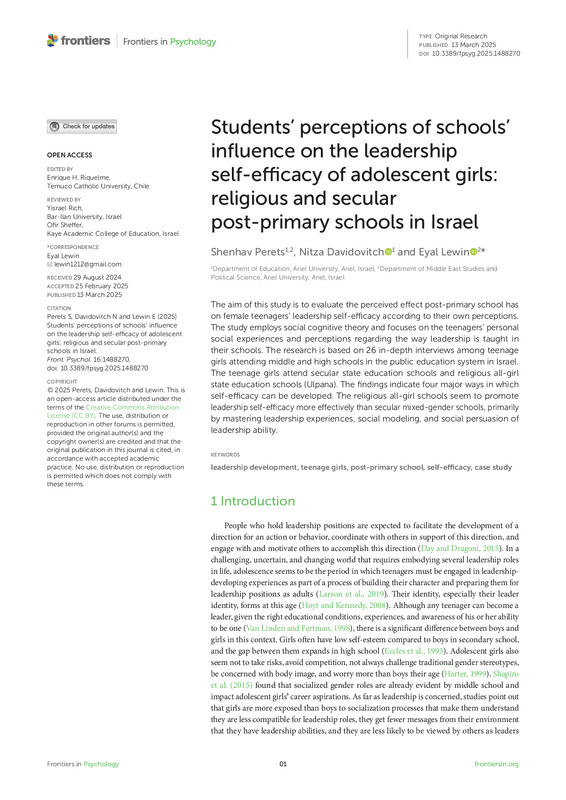 Students’ perceptions of schools’ influence on the leadership self-efficacy of adolescent girls: religious and secular post-primary schools in IsraelPerets Shenhav , Davidovitch Nitza , Lewin Eyal (2025) 2025Overview This qualitative study explores how different school contexts shape adolescent girls’ confidence in their leadership abilities. Drawing on Social Cognitive Theory, the authors focus on three main pathways that influence leadership self-efficacy: mastery experiences, social modeling, and social persuasion . The research highlights how school structures, culture, and peer/teacher interactions can either limit or expand opportunities for girls to see themselves as capable leaders, with meaningful differences emerging between secular mixed-gender schools and religious all-girls schools. Key Findings Mastery Experiences: Girls in religious schools had more opportunities to practice leadership, both in school and through youth organizations. Social Modeling: Religious school students identified teachers, older peers, and guides as leadership role models; secular school students did not report strong models. Social Persuasion: Religious schools provided consistent encouragement from teachers, peers, and youth leaders, reinforcing girls’ leadership confidence. Secular school students reported little direct encouragement. Overall Impact: Religious all-girls schools fostered stronger leadership self-efficacy than secular mixed-gender schools by providing richer experiences, visible role models, and affirmational support. Implications for Girls’ Schools Structured opportunities for leadership and visible female role models are critical in developing leadership confidence among adolescent girls. Encouragement and affirmation from adults and peers can significantly influence students’ belief in their leadership capacity. The findings challenge assumptions that secular, coeducational settings are inherently more supportive of girls’ leadership development, highlighting the unique value of all-girls environments. Reference Perets, S., Davidovitch, N., & Lewin, E. (2025). "Students’ perceptions of schools’ influence on the leadership self-efficacy of adolescent girls: religious and secular post-primary schools in Israel." Frontiers in Psychology, 16. https://doi.org/10.3389/fpsyg.2025.1488270