-
Title
-
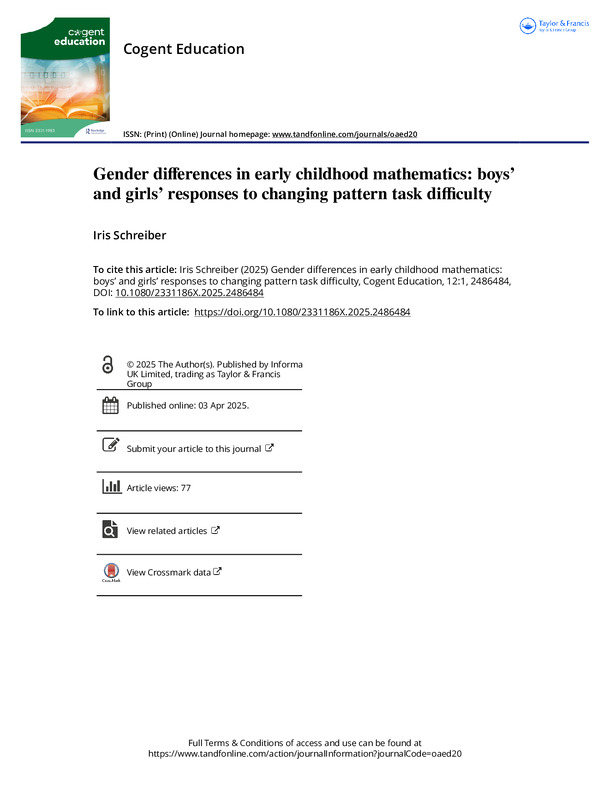
Gender differences in early childhood mathematics: boys’ and girls’ responses to changing pattern task difficulty
-
Author
-
Iris Schreiber (2025)
-
Year Published
-
2025
-
Description
-
The study by Iris Schreiber (2025) investigates gender differences in how kindergarten children solve repeating pattern tasks, particularly when task difficulty increases through the inclusion of surplus shapes and colors. Conducted with 206 Israeli children aged 4–6, the research found no gender differences when only necessary items were provided—both boys and girls performed equally well. However, when surplus items were added, performance declined overall, with girls outperforming boys. Girls were more likely to solve the tasks correctly or declare the task unsolvable, while boys more often produced random or alternate repeating patterns.
These findings suggest that girls may be more adept at filtering out irrelevant information or more cautious in uncertain situations, possibly due to lower self-confidence in math tasks. Conversely, boys appeared more easily distracted by extraneous elements and were more prone to guessing. The study emphasizes the importance of teaching strategies that foster pattern recognition and generalization, rather than procedural repetition, and advocates for differentiated instructional approaches that support both genders in early math learning.
-
Type
-
Research Report
-
Research Category
-
Learning
-
Teaching
-
STEM & STEAM
-
Year of Study
-
2025
-
Identifier
-
44859