
STEM and STEAM
- Title
- STEM and STEAM
Items
-
 Academic Buoyancy: Empowering Year 9 and 10 Girls to Take Risks and Own Their Learning as They Problem-Solve in the Science ClassroomLinda Douglas (2021) 2021This action research project sought to explore how supporting Year 9 and 10 girls’ understanding of their personal academic buoyancy and associated strategies impacted their academic risk-taking and ownership of learning when problem-solving in Science. In July 2021, a class of 23 Year 9 and 10 girls at Ruyton Girls’ School commenced a one semester Science elective entitled Marine Encounters. Early in this course, they were introduced to the concept of “academic buoyancy” through a bespoke workshop delivered over two fifty-minute sessions. The workshop focused on understanding cognition, behaviours, and emotions to support personal academic buoyancy, particularly during problem-solving exercises. The students then engaged in a series of authentic scientific problem-solving activities as part of their scientific study, which provided opportunities to put the academic buoyancy strategies into practice. In a mixed methods research design, data were collected through a pre-activity and post-activity survey, written student and staff reflections, and focus-group interviews towards the end of the elective. Analysis of the data indicated increased students’ awareness of negative thoughts about their own learning, recognition of their own personal signs of anxiety and worry, and greater recognition of the aspects they could control and develop. Student agency emerged as a strong theme, with students identifying not only how the action supported them in taking greater control of their own learning, but also how it could be improved in the future to support younger students. The results of this project indicate that a deliberate and embedded approach to teaching girls’ academic buoyancy and associated strategies enhanced openness to academic risk-taking and increased ownership of learning.
 -
 Can STEM outreach activities help address gaps in the STEM pipeline? Exploring an Irish primary school case studyICGS 2025A new case study based on primary school girls’ attitudes towards STEM in Ireland takes important steps in considering ways to address disengagement and loss of interest in STEM. Researchers from the University of Limerick and University of Galway have developed this article to respond to the gap in the STEM “pipeline”, which has become a well-recognised source of a “lack of participation, progression, and achievement in STEM education for females” (Johnson et al., 2025, p. 221). Previous research based on these gaps and possible interventions have often focussed on “only one or two STEM disciplines” (Johnson et al., 2025, p. 221). This article goes further to consider all four disciplines through a case study of a STEM outreach activity and its impact on Irish primary school girls’ attitudes towards STEM (Johnson et al., 2025, p. 221). The article discusses “STEM outreach”, which is used to “classify activities that are delivered ‘outside of the traditional student/teacher relationship to STEM stakeholders (students, parents, teachers…) in order to support and increase the understanding, awareness and interest in STEM disciplines’” (Johnson et al., 2025, p. 224). This case study is based on the Spaceship earth project, a project run between the University of Galway, University of Limerick and the Irish meteorological service Met Éireann. The project engaged students in real-world, project-based experiments in the classroom with the intention of engaging and educating teachers, students and the public about STEM. Students developed their own experiments that involved “launching high-altitude balloons to the edge of space”, before analysing and reporting on their experiment (Johnson et al., 2025, pp. 224-225). It also included workshops for students where they could explore STEM project ideas. While multiple schools were initially involved in the project, due to withdrawal from various aspects of the research, the case study is based on one all-girls school located in the west of Ireland. Fifty-one students from the school participated in the study, all aged between nine and ten years. Due to pandemic restrictions at the time, some parts of the project were converted to run online, which included the workshops. The research also involved pre- and post-project surveys to better understand the impact of the outreach activity on girls’ attitudes. Before participating, the researchers observed that all girls had a positive attitude generally towards STEM. However, the age of the students in the study is consistent with the stage where this attitude has been shown to change. After participating in the project, there was no significant change in these attitudes. This was viewed as an “encouraging result” due to the presence of positive attitudes prior to participation, and continuation of these results, especially in light of a typical negative change at this point in time (Johnson et al., 2025, p. 230). Despite this outcome, the authors noted a particular concern regarding a decline in girls’ attitudes specifically towards science as a STEM discipline over the course of the study. This reflects some similarities to other research. While this outcome is not specific to this study, it highlights the need to consider specific STEM subjects, including attitudes and required interventions, in addition to STEM itself as a broader study area. While a relatively small study, these outcomes are important for schools and educators, as they show the potential benefits of a STEM outreach activity on girls’ attitudes towards STEM generally. This is especially worthy of consideration given that the girls who participated in this project retained their positive attitudes toward STEM at a time when research shows this typically declines. While the authors note that a larger-scale project could provide additional insight into this finding, this is a useful outcome for schools to consider when planning interventions for girls. Until further research is forthcoming, the authors additionally suggest that between the ages of ten and 14 these outcomes and attitudes are nonetheless monitored closely due to the risk factors of declining positivity towards STEM (Johnson et al., 2025, p. 229). The researchers also suggest that educators and school leaders consider how outreach activities intersect with the traditional school curriculum. Rather than assuming that each operates in isolation, this provides a space to consider how these different activities interact as part of a broader approach. A key challenge identified in the project is the specific decline in positive attitudes towards science , even as overall STEM attitudes remained stable. One way to address the decline in specific STEM subjects (rather than STEM overall) is to ensure learning is “more evenly distributed across each of the STEM disciplines” (Johnson et al., 2025, p. 231). This highlights a need to enhance girls’ proficiency in each subject in order to e
 -
 Developing Self-Efficacy Through Collaboration: Building Math Confidence in Grade 6 Girls Through Academic Discussion SkillsDuncan Flaherty (2025) 2025This action research study examined the impact of academic discussion skills on developing discipline-specific self-efficacy in two Grade 6 girls’ math classes using the R.E.A.L.® discussion framework. This intervention addressed the gender confidence gap in mathematics learning, whereby girls report lower levels of math confidence than boys in their peer group (Zander et al., 2020). Research shows that cooperative learning is an effective tool for teaching mathematical problem-solving in a whole class context (Klang et al., 2021), and that combining scaffolding for discussion skills and math content can increase conceptual understanding (Kazak et al., 2015). I contended that math discussion skills provide a mechanism to increase math self-efficacy through their capacity to enable mastery experiences, vicarious experiences, social persuasion, and positive emotional states, which are the primary sources of self-efficacy (Bandura, 1997). A math-specific version of the R.E.A.L.® discussion framework, initially developed for use in humanities classes, was generated in a collaboration between R.E.A.L.® and me and piloted during the six-week action research period. The research was conducted at Nashoba Brooks School in Concord, Massachusetts, USA. The project began with a student orientation to the R.E.A.L.® discussion framework, where students learned the primary tools (relate, evidence, ask, and listen) they would use during discussions, as well as how to prepare notes for discussions and write post-discussion reflections. Collected data were primarily 2 qualitative in discussion question preparation notes, reflection notes, student journal entries, field note observations, and video recordings of discussions. Quantitative data were collected through Likert scale surveys administered throughout the intervention to measure self-reported math self-efficacy. Data were analyzed through organization, description, and interpretation using a coding process that grouped data into frequently recurring themes (Mertler, 2020). This action research study found that math-specific academic discussion skills using the R.E.A.L.® framework increased student confidence when discussing and understanding math material. Specifically, the R.E.A.L.® discussions generated evidence of growth in all four areas of self-efficacy development as outlined by Bandura (1997). The findings are significant for math educators and leaders in girls’ schools as they suggest that math-specific academic discussion skills are effective in closing the gender confidence gap in mathematics learning. Future practice should incorporate explicit teaching of discussion skills alongside other constructivist modes of instruction to maximize self-efficacy development opportunities in math classes.
 -
 Encouraging Risk-Taking in Year 12 Girls Through a Collaborative Approach to Solving Non-Routine Questions in Higher Level MathematicsJanet Hunter (2023) 2023Maximising examination readiness for Year 12 students between the internal “trial” examinations and the final state matriculation examinations six school weeks later is always a challenge, especially in the higher levels of Mathematics. Traditionally girls complete a practice paper each week, correct their mistakes, then move onto the next one. They do not necessarily master the techniques they were unable to do or got wrong in the practice papers, leaving them open to the same errors in the final examination. This research project addresses this preparation loophole for a group of ten pre-matriculation girls studying the elite course, Mathematics Extension 2 in New South Wales, Australia. Three elements for girls’ success were identified and implemented as the action of this action research project: first, facilitating Year 12 girls to work collaboratively on mathematical problems to increase confidence; second, working on difficult, non-routine mathematical problems; and third, not providing solutions to mathematical problems. The results are encouraging and suggest that confidence increases by working collaboratively to the point where girls are fearless and ready to attempt questions individually; the skill required for success in the final external matriculation examination.
 -
 Gender differences in early childhood mathematics: boys’ and girls’ responses to changing pattern task difficultyIris Schreiber (2025) 2025The study by Iris Schreiber (2025) investigates gender differences in how kindergarten children solve repeating pattern tasks, particularly when task difficulty increases through the inclusion of surplus shapes and colors. Conducted with 206 Israeli children aged 4–6, the research found no gender differences when only necessary items were provided—both boys and girls performed equally well. However, when surplus items were added, performance declined overall, with girls outperforming boys. Girls were more likely to solve the tasks correctly or declare the task unsolvable, while boys more often produced random or alternate repeating patterns. These findings suggest that girls may be more adept at filtering out irrelevant information or more cautious in uncertain situations, possibly due to lower self-confidence in math tasks. Conversely, boys appeared more easily distracted by extraneous elements and were more prone to guessing. The study emphasizes the importance of teaching strategies that foster pattern recognition and generalization, rather than procedural repetition, and advocates for differentiated instructional approaches that support both genders in early math learning.
 -
Girls scared away from science by sexist banter at co-ed schoolsIOP 2015A new report by Britain's Institute of Physics has found that co-educational schools need to do more to tackle sexist banter and attitudes that discourage girls from pursuing careers in science. While the Opening Doors report found that all schools had policies to counter racist, sexist and homophobic language, sexist language was often dismissed as "harmless banter" though "many of the students, particularly girls, did not see it as such" and that "in extreme cases, it verged on bullying". Some of the many important findings of the Opening Doors report include that: Many of the schools were "inadvertently reinforcing the notion that certain subjects were harder than others" and that girls "lack ability" and "innate talent" in certain subjects, and this was "particularly true for girls contemplating mathematics and the physical sciences". Timetabling constraints in many schools reinforced gender stereotypes through offering subjects in blocks that send "a strong message about the types of courses that are taken by boys and girls". "Some schools, mindful of bad behaviour from boys, had policies of alternate boy-girl seating, effectively using the girls as buffers to keep the boys apart. In general the girls noticed and resented this policy." While girls had access to the full range of sporting activities at some schools, in other schools "girls resented being prevented from taking certain sports considered unsuitable for them". In 2012, the Institute of Physics published the It's Different for Girls report which found that 49% of all government co-ed schools did not have a single female student taking A-level physics and that girls attending independent single-sex schools were four times more likely to take A-level physics than girls in government co-ed schools. In fact, 7.2% of girls in single-sex independent schools took A-level physics in 2011 compared with 4.9% of girls in co-ed independent schools, 4.3% of girls in single-sex government schools and 1.8% of girls in co-ed government schools. In 2013 the Institute followed this report with its Closing Doors report examining existing gender imbalances in six A-level subjects which result in girls being more likely to take English, biology and psychology, and boys being more likely to take mathematics, physics and economics. The report found that 81% of government co-educational schools were either "maintaining or exacerbating the already poor gender bias of progression into these subjects". One of the main findings of the report, however, was that "single-sex schools are significantly better than co-educational schools at countering gender imbalances in progression to these six subjects". References Institute of Physics. (2013). Closing doors: Exploring gender and subject choice in schools . Retrieved from: https://www.iop.org/education/teacher/support/girls_physics/closing-doors/page_62076.html Institute of Physics. (2015). Opening doors: A guide to good practice in countering gender stereotyping in schools . Retrieved from: https://www.iop.org/education/teacher/support/girls_physics/reports-and-research/opening-doors/page_66438.html
-
Is it a Matter of Skills? High School Choices and the Gender Gap in STEMDalit Contini, Maria Laura Di Tommaso, Anna Maccagnan and Silvia Mendolia (2025) 2025This article investigates the extent to which gender differences in academic skills contribute to the gender gap in STEM (Science, Technology, Engineering, and Mathematics) high school tracks in Italy. Focusing on the critical educational transition at age 14, when Italian students select among various secondary school types, the study examines whether disparities in mathematics and language skills—where boys typically outperform in math and girls in language—account for the underrepresentation of girls in STEM-oriented schools. The findings reveal that while academic skills do influence school choice, they only partially explain the gender gap in STEM enrollment, particularly among students from higher socio-economic backgrounds. For students from less educated families, skill differences have minimal explanatory power regarding the gender disparity in STEM choices. The research suggests that factors beyond measurable academic abilities, such as societal norms, stereotypes, and possibly differences in self-confidence or interest, significantly influence the gendered patterns in educational pathways. The study emphasizes that simply addressing skill gaps may not suffice to close the gender divide in STEM fields. Instead, comprehensive strategies that also tackle cultural and psychological barriers are necessary to encourage more equitable participation in STEM education and, by extension, in related career fields. Key Finding: "Teacher grades and test scores strongly influence choices, but the impact of ability differs by gender. Girls are less likely to opt for STEM high schools unless they excel in mathematics or have a strong comparative advantage in the subject. Conversely, boys often choose STEM pathways regardless of weak math performance and continue to do so even when they excel in Italian. Consistent with prior research, our findings suggest that girls require stronger evidence of their mathematical ability than boys to pursue STEM studies."
-
Plugging the gaps in the STEM pipeline: A reproducible, scalable model that supports middle school and undergraduate females studyingAkin, V., Santillan, S. T., & Valentino (2024) 2024Developing new and innovative ways to support girls in STEM is high on the agenda of girls’ schools globally. Researchers from Duke University have developed a reproducible model that targets two key periods when girls are more likely to leave STEM studies – middle school and tertiary undergraduate studies. They do this by focussing on helping girls develop their own STEM identity. This is crucial, because stereotypes about who should study STEM have been found to have a significant impact on girls being able to see themselves in STEM careers (International Coalition of Girls’ Schools [ICGS], 2024). This research represents a unique mentoring model that can be scaled up or down and replicated in girls’ schools to help support students as they seek to follow their STEM aspirations. Despite numerous interventions that have been developed to support female STEM engagement, there still exists a significant drop in girls’ participation in STEM during middle school and the undergraduate years of tertiary study (Akin et al., 2024, p. 452). This has been linked to a “clear shift in girls’ social identity relative to mathematics during middle school”, and a further decrease in female STEM enrolments after completing secondary school (Akin et al., 2024, p. 452). In particular, self-confidence in mathematics can have a significant impact on girls’ STEM identities more broadly. An interdisciplinary group of both researchers and STEM practitioners have developed a model called Improving Girls’ Math Identity (IGMI) to address these issues at both undergraduate college level and middle school. The IGMI programme involves the recruitment and training of undergraduate women studying STEM to become mentors and workshop leaders for local middle school girls. This serves a dual purpose of providing mentoring and workshop opportunities to adolescent girls, and also the creation of a network of female STEM undergraduate students. IGMI was designed to help undergraduate women and middle school girls develop a positive mathematics or STEM identity. This was intended to improve not only their beliefs and attitudes about STEM, but also “the degree to which they see themselves as members of the corresponding community” (Akin et al., 2024, p. 453). Undergraduate students were provided with the necessary training and materials to deliver workshops and mentoring to middle school girls. The research case study included this content as part of a broader curriculum, however, it can also be offered as an extra-curricular offering. IGMI was run successfully three times during this research, in both in-person and virtual formats (due to pandemic restrictions). The IGMI goals are achieved through three key approaches to support the development of a positive STEM identity. The first is the belief that the student is capable of completing the training necessary to be a STEM professional. The second is the belief that a STEM-related career is “personally relevant and meaningful to the student’s broader life goals” (Akin et al., 2024, p. 454). Finally, this connects with the belief that STEM fields, both educationally and professionally, have the capacity to be a welcoming environment – something that is also supported through the development of healthy, positive female STEM networks during the IGMI programme. Targeting these three areas responds to research showing that developing a positive mathematics or STEM identity is crucial to supporting girls who wish to pursue study in this field. (ICGS, 2024). IGMI also focusses on enhanced mathematical skills building. This includes metacognition, problem-based learning, and spatial reasoning. Developed as a scalable model that can be replicated in girls’ schools, the IGMI intervention provides benefits for both the middle school and undergraduate participants. Both middle school girls and women in undergraduate courses who participated in IGMI showed “improved mathematical self-efficacy and confidence” (Akin et al., 2024, p. 453). This was especially apparent in the presentation of mathematical work, problem-solving skills, and improved skills when approaching new problems. Beyond these skills, however, there also exists the development of a professional support network among undergraduate women, and a positive mentorship programme for middle school girls. Undergraduate women also gained an increased understanding of barriers to female participation in STEM, which in turn led participants to feel more empowered when navigating the STEM environment in their university studies and potential employment opportunities. It also led to improved confidence and leadership skills, and an increased desire from undergraduate women to maintain ongoing involvement in supporting adolescent girls on their own STEM journeys. This model represents an important opportunity for girls’ schools to bring together adolescent girls and undergraduate women who have a shared interest and desire to study STEM, while al
-
Teacher gender biases exist and have long-term effectsRigissa Megalokonomou, Victor Lavy (2023) 2023This article examines the impact of teacher gender biases on student outcomes, particularly in STEM education. Using administrative data from Greece, where students are quasi-randomly assigned to teachers, the study identifies significant gender biases among high school teachers, especially in mathematics. Teachers' biases were measured by comparing student performance on blind (externally graded) and non-blind (teacher-graded) exams. The findings reveal that teachers who favor boys tend to grade male students higher than female students, despite similar performance on blind assessments. This bias adversely affects girls' subsequent academic performance and their likelihood of enrolling in STEM degrees. The study also finds that teacher gender biases are persistent over time and across different classes, indicating deeply rooted attitudes. Students exposed to pro-boy teachers in grade 11 show significant changes in performance and educational choices in grade 12 and beyond. Specifically, girls taught by pro-boy teachers are less likely to pursue STEM degrees, while boys taught by pro-girl teachers are less likely to enroll in university or choose high-quality degrees. These findings underscore the long-term implications of teacher biases on students' educational trajectories and highlight the need for interventions to address and mitigate such biases in educational settings.
-
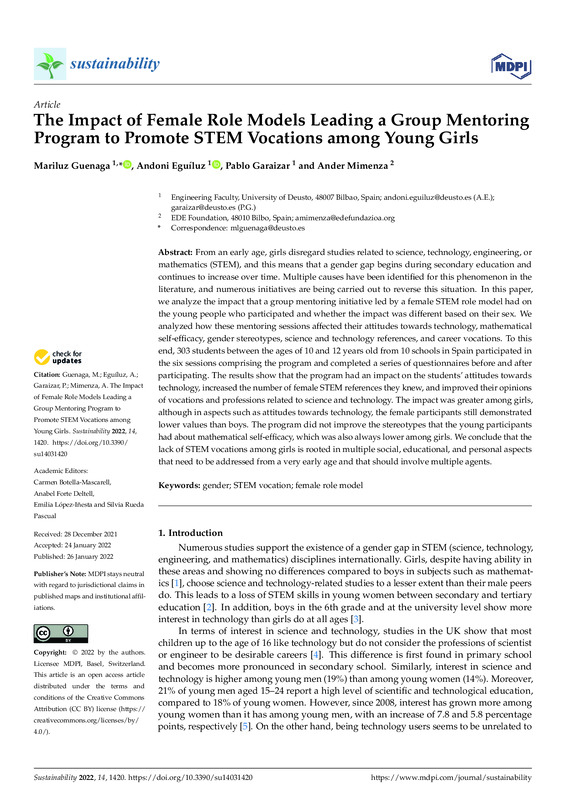 The Impact of Female Role Models Leading a Group Mentoring Program to Promote STEM Vocations among Young GirlsMariluz Guenaga, Andoni Eguíluz, Pablo Garaizar and Ander Mimenza (2022) 2022Synopsis: From an early age, girls disregard studies related to science, technology, engineering, or mathematics (STEM), and this means that a gender gap begins during secondary education and continues to increase over time. Multiple causes have been identified for this phenomenon in the literature, and numerous initiatives are being carried out to reverse this situation. In this paper, we analyze the impact that a group mentoring initiative led by a female STEM role model had on the young people who participated and whether the impact was different based on their sex. We analyzed how these mentoring sessions affected their attitudes towards technology, mathematical self-efficacy, gender stereotypes, science and technology references, and career vocations. To this end, 303 students between the ages of 10 and 12 years old from 10 schools in Spain participated in the six sessions comprising the program and completed a series of questionnaires before and after participating. The results show that the program had an impact on the students’ attitudes towards technology, increased the number of female STEM references they knew, and improved their opinions of vocations and professions related to science and technology. The impact was greater among girls, although in aspects such as attitudes towards technology, the female participants still demonstrated lower values than boys. The program did not improve the stereotypes that the young participants had about mathematical self-efficacy, which was also always lower among girls. We conclude that the lack of STEM vocations among girls is rooted in multiple social, educational, and personal aspects that need to be addressed from a very early age and that should involve multiple agents.