2023-24 GARC Research Reports: Collaboration
- Title
- 2023-24 GARC Research Reports: Collaboration
- Related Resources
-

Global Action Research Reports
- Date
- 2024
- Subject
- Collaboration
Items
-
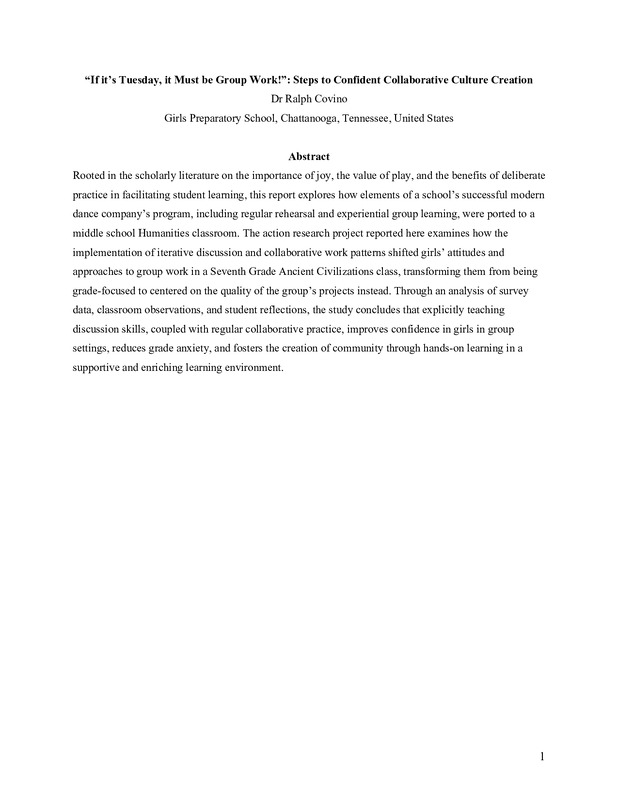
“If it’s Tuesday, it Must be Group Work!”: Steps to Confident Collaborative Culture CreationDr. Ralph Covino (2024) 2024Rooted in the scholarly literature on the importance of joy, the value of play, and the benefits of deliberate practice in facilitating student learning, this report explores how elements of a school’s successful modern dance company’s program, including regular rehearsal and experiential group learning, were ported to a middle school Humanities classroom. The action research project reported here examines how the implementation of iterative discussion and collaborative work patterns shifted girls’ attitudes and approaches to group work in a Seventh Grade Ancient Civilizations class, transforming them from being grade-focused to centered on the quality of the group’s projects instead. Through an analysis of survey data, classroom observations, and student reflections, the study concludes that explicitly teaching discussion skills, coupled with regular collaborative practice, improves confidence in girls in group settings, reduces grade anxiety, and fosters the creation of community through hands-on learning in a supportive and enriching learning environment.
-
Empowering Environmental Guardians: Using Collaborative Systems Thinking to Solve Real-World Problems in a Year 10 Girls’ Science ClassroomAlex van der Loos 2024This action research study delves into the intersection of systems thinking, collaborative skills, and the empowerment of 14–15-year-old girls in a Year 10 Science classroom as kaitiaki (environmental guardians). The project aimed to enhance the confidence and collaborative capabilities of the girls through the implementation of systems thinking techniques within the context of an environmental awareness campaign centred around a local waterway, Wairau Creek. In teacher-selected teams of 4-6 students, the girls were granted autonomy in structuring their collaborative groups, with no predefined roles or instructions provided. Emphasising the interconnectedness of environmental systems, the curriculum guided students through the exploration of a nearby creek, conducting water health assessments and engaging with community experts to gain insights into the challenges facing the waterway. This study builds on existing literature regarding systems thinking, extending its application to address a notable gap – the impact on, and implications for, girls' collaborative skills. By allowing students the freedom to apply systems thinking as they deemed appropriate, this research uncovered how such an approach influences the development of teamwork, relationships, communication, and leadership skills among girls, with an aim to be shared with different departments across the school and to be easily implemented at any year level by educators across the globe.
-
Fostering Engagement in a Year 10 Girls’ Biology Classroom through Development of a Collaborative CultureClaire Saxon (2024) 2024Whilst girls demonstrate a propensity for social learning, classroom collaboration does not always lead to positive outcomes. Working together can lead to dissatisfaction, a reduction in engagement and a reliance on formulaic presentations rather than embracing a love of learning in a Year 10 Biology classroom. Girls at my school have been observed to collaborate effectively in Drama or Physical Education lessons but unable to transfer this skill to Biology. The aim of this action research project was to enable girls to change the perception of success in Biology and gather evidence of any change. This was the inspiration for an examination of re-addressing the balance in a more teacher-led classroom by adapting Ritchhart and Church’s (2020) routines in The power of making thinking visible. Girls in a Year 10 Biology class at Wycombe High School were participants in a study where deliberate routines were planned and delivered in a sequence of Biology lessons to engage students in learning and working together to achieve a common goal. Data were collected as part of a mixed methods approach. Data analysis suggested an increase in feelings of belonging and inclusion. Themes of academic trust, and the ability of students to use and organically apply the skills they learned during the collaborative learning activities were identified. Initial evidence also suggests that anxiety decreased as students were able to build critical relationships and trust with their peers whilst exploring more abstract ideas. The findings also indicate that girls were more likely to participate in robust learning conversations after the action. The intended outcomes served to challenge the apparent predominant pedagogy in different contexts which had been observed in a high-achieving, single-sex girls’ school and to foster a collaborative culture in areas where this is not usually expected. To develop this study further, there is a need to explore the relationship between collaboration, academic trust, and metacognition.
-
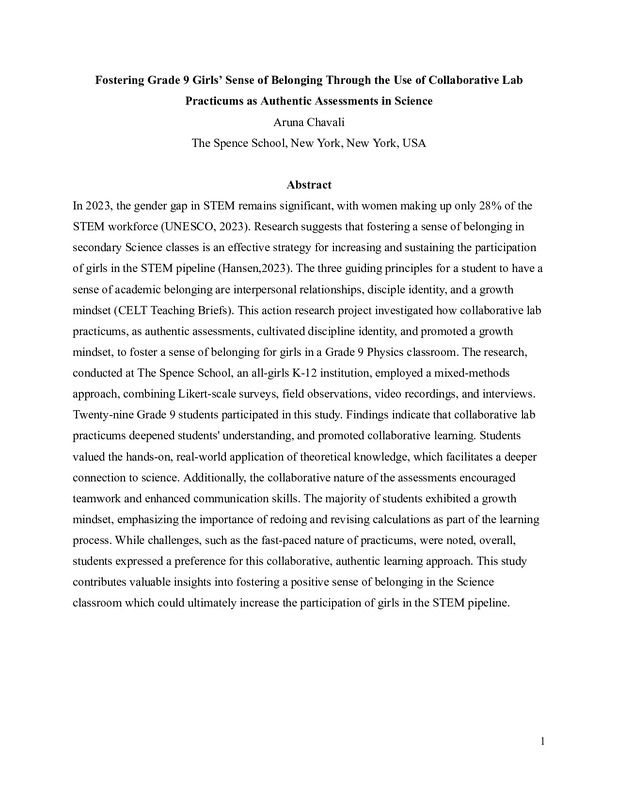
Fostering Grade 9 Girls’ Sense of Belonging Through the Use of Collaborative Lab Practicums as Authentic Assessments in ScienceAruna Chavali (2024) 2024In 2023, the gender gap in STEM remains significant, with women making up only 28% of the STEM workforce (UNESCO, 2023). Research suggests that fostering a sense of belonging in secondary Science classes is an effective strategy for increasing and sustaining the participation of girls in the STEM pipeline (Hansen,2023). The three guiding principles for a student to have a sense of academic belonging are interpersonal relationships, disciple identity, and a growth mindset (CELT Teaching Briefs). This action research project investigated how collaborative lab practicums, as authentic assessments, cultivated discipline identity, and promoted a growth mindset, to foster a sense of belonging for girls in a Grade 9 Physics classroom. The research, conducted at The Spence School, an all-girls K-12 institution, employed a mixed-methods approach, combining Likert-scale surveys, field observations, video recordings, and interviews. Twenty-nine Grade 9 students participated in this study. Findings indicate that collaborative lab practicums deepened students' understanding, and promoted collaborative learning. Students valued the hands-on, real-world application of theoretical knowledge, which facilitates a deeper connection to science. Additionally, the collaborative nature of the assessments encouraged teamwork and enhanced communication skills. The majority of students exhibited a growth mindset, emphasizing the importance of redoing and revising calculations as part of the learning process. While challenges, such as the fast-paced nature of practicums, were noted, overall, students expressed a preference for this collaborative, authentic learning approach. This study contributes valuable insights into fostering a positive sense of belonging in the Science classroom which could ultimately increase the participation of girls in the STEM pipeline.