
2022-23 GARC Research Reports: The Global Reset
- Title
- 2022-23 GARC Research Reports: The Global Reset
- Related Resources
-
 Global Action Research Reports
Items
-
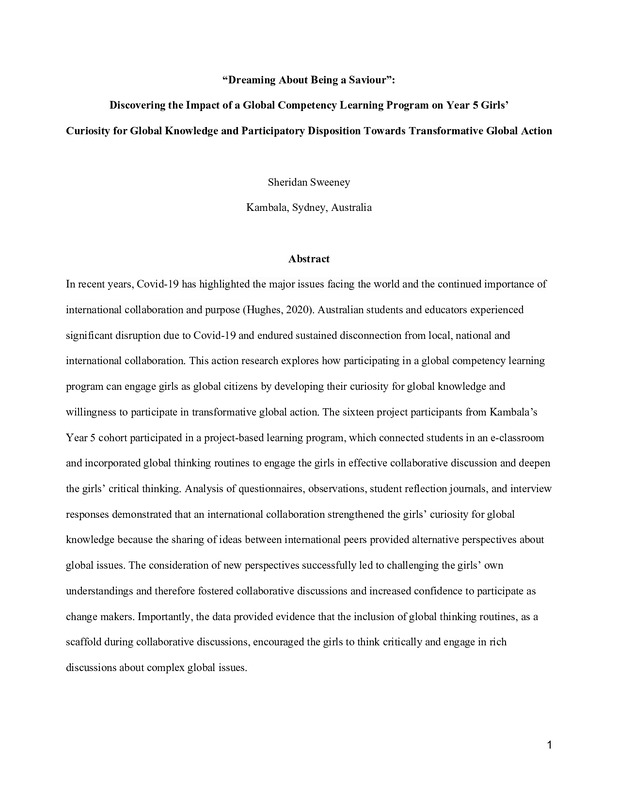 “Dreaming About Being a Saviour”: Discovering the Impact of a Global Competency Learning Program on Year 5 Girls’ Curiosity for Global Knowledge and Participatory Disposition Towards Transformative Global ActionSheridan Sweeney 2023In recent years, Covid-19 has highlighted the major issues facing the world and the continued importance of international collaboration and purpose (Hughes, 2020). Australian students and educators experienced significant disruption due to Covid-19 and endured sustained disconnection from local, national and international collaboration. This action research explores how participating in a global competency learning program can engage girls as global citizens by developing their curiosity for global knowledge and willingness to participate in transformative global action. The sixteen project participants from Kambala’s Year 5 cohort participated in a project-based learning program, which connected students in an e-classroom and incorporated global thinking routines to engage the girls in effective collaborative discussion and deepen the girls’ critical thinking. Analysis of questionnaires, observations, student reflection journals, and interview responses demonstrated that an international collaboration strengthened the girls’ curiosity for global knowledge because the sharing of ideas between international peers provided alternative perspectives about global issues. The consideration of new perspectives successfully led to challenging the girls’ own understandings and therefore fostered collaborative discussions and increased confidence to participate as change makers. Importantly, the data provided evidence that the inclusion of global thinking routines, as a scaffold during collaborative discussions, encouraged the girls to think critically and engage in rich discussions about complex global issues.
 -
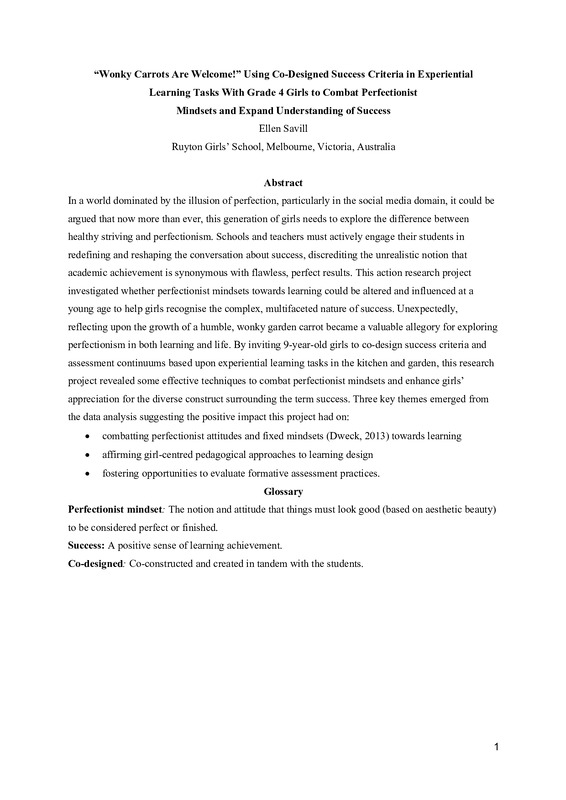 “Wonky Carrots Are Welcome!” Using Co-Designed Success Criteria in Experiential Learning Tasks With Grade 4 Girls to Combat Perfectionist Mindsets and Expand Understanding of SuccessEllen Savill (2023) 2023In a world dominated by the illusion of perfection, particularly in the social media domain, it could be argued that now more than ever, this generation of girls needs to explore the difference between healthy striving and perfectionism. Schools and teachers must actively engage their students in redefining and reshaping the conversation about success, discrediting the unrealistic notion that academic achievement is synonymous with flawless, perfect results. This action research project investigated whether perfectionist mindsets towards learning could be altered and influenced at a young age to help girls recognise the complex, multifaceted nature of success. Unexpectedly, reflecting upon the growth of a humble, wonky garden carrot became a valuable allegory for exploring perfectionism in both learning and life. By inviting 9-year-old girls to co-design success criteria and assessment continuums based upon experiential learning tasks in the kitchen and garden, this research project revealed some effective techniques to combat perfectionist mindsets and enhance girls’ appreciation for the diverse construct surrounding the term success. Three key themes emerged from the data analysis suggesting the positive impact this project had on:Ruyton Girls’ School combatting perfectionist attitudes and fixed mindsets (Dweck, 2013) towards learning affirming girl-centred pedagogical approaches to learning design fostering opportunities to evaluate formative assessment practices.
 -
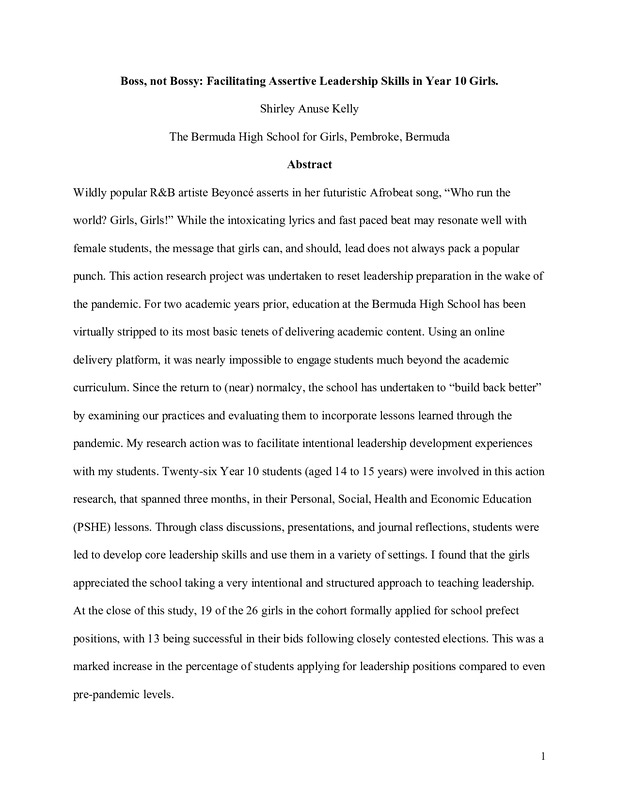 Boss, not-bossy: facilitating assertive leadership-skills in year 10 girlsShirley Anuse Kelly (2023) 2023Wildly popular R&B artiste Beyoncé asserts in her futuristic Afrobeat song, “Who run the world? Girls, Girls!” While the intoxicating lyrics and fast paced beat may resonate well with female students, the message that girls can, and should, lead does not always pack a popular punch. This action research project was undertaken to reset leadership preparation in the wake of the pandemic. For two academic years prior, education at the Bermuda High School has been virtually stripped to its most basic tenets of delivering academic content. Using an online delivery platform, it was nearly impossible to engage students much beyond the academic curriculum. Since the return to (near) normalcy, the school has undertaken to “build back better” by examining our practices and evaluating them to incorporate lessons learned through the pandemic. My research action was to facilitate intentional leadership development experiences with my students. Twenty-six Year 10 students (aged 14 to 15 years) were involved in this action research, that spanned three months, in their Personal, Social, Health and Economic Education (PSHE) lessons. Through class discussions, presentations, and journal reflections, students were led to develop core leadership skills and use them in a variety of settings. I found that the girls appreciated the school taking a very intentional and structured approach to teaching leadership. At the close of this study, 19 of the 26 girls in the cohort formally applied for school prefect positions, with 13 being successful in their bids following closely contested elections. This was a marked increase in the percentage of students applying for leadership positions compared to even pre-pandemic levels.
 -
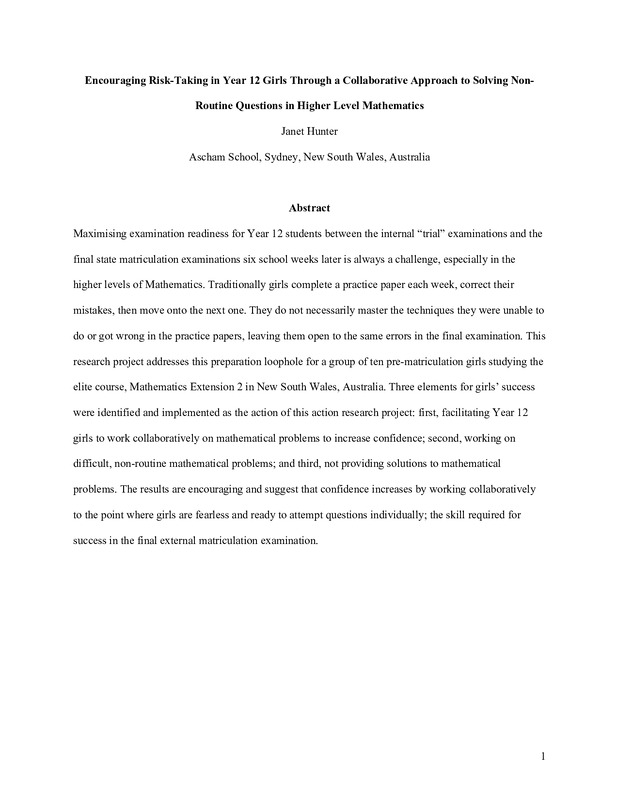 Encouraging Risk-Taking in Year 12 Girls Through a Collaborative Approach to Solving Non-Routine Questions in Higher Level MathematicsJanet Hunter (2023) 2023Maximising examination readiness for Year 12 students between the internal “trial” examinations and the final state matriculation examinations six school weeks later is always a challenge, especially in the higher levels of Mathematics. Traditionally girls complete a practice paper each week, correct their mistakes, then move onto the next one. They do not necessarily master the techniques they were unable to do or got wrong in the practice papers, leaving them open to the same errors in the final examination. This research project addresses this preparation loophole for a group of ten pre-matriculation girls studying the elite course, Mathematics Extension 2 in New South Wales, Australia. Three elements for girls’ success were identified and implemented as the action of this action research project: first, facilitating Year 12 girls to work collaboratively on mathematical problems to increase confidence; second, working on difficult, non-routine mathematical problems; and third, not providing solutions to mathematical problems. The results are encouraging and suggest that confidence increases by working collaboratively to the point where girls are fearless and ready to attempt questions individually; the skill required for success in the final external matriculation examination.
 -
 Facilitating Ownership in Social-Emotional Learning: Grade 3 Girls’ Co-Created Mindful Routines Foster Self-Regulation and Resiliency SkillsAnnMarie Zigrossi (2023) 2023This action research project explores how 7-8 year-old girls co-created mindful routines as a strategy to foster self-regulation and resiliency. This research was conducted with a group of 14 Grade 3 students at an all-girls independent school in Toronto, Canada. The project examined how students could more independently access taught mindfulness strategies when faced with challenges throughout their day. While most research in this area focuses on the beneficial outcomes of participating in mindfulness practices and the long-term positive effects on academics and social interactions, there is less information on how students can more independently access these practices in their daily lives. In this project, the girls created a well-structured mindful routine that they practised each morning and had access to throughout their day. Students exhibited a sense of ownership in creating their unique mindful routine, which led to high levels of engagement and autonomy. The students used critical thinking skills to research various mindful practices and experimented, tested, and self-reflected to discern the practices that best suited them. Data were collected while the girls participated in their individual mindful routine each morning over a six-week period. Data collected were qualitative in nature and captured by questionnaires, interviews, observations and student journals. The results indicated that the students independently accessed this tool to support them through regular daily challenges, such as working through feeling frustrated or overwhelmed, resolving conflicts with peers at recess, and managing anxiety at competitive sporting events. The girls articulated the positive impact of using their mindful routine and how they plan to use this tool in the future. These mindful routines were used as a tool for self-regulation and demonstrated the development of resiliency skills that students can access throughout their lives to enhance their well-being. Facilitating young students’ creation of mindful routines to develop these skills and recognize their immediate positive impact will be key in the school’s future planning of Social-Emotional Learning (SEL). By AnnMarie Zigrossi
 -
 Who Controls the Learning? Examining the Impact of an Autodidactic Framework in a Grade 12 Girls’ Atmospheric Science ClassEric A. Walters (2023) 2023A 21st-century education must move beyond a student acquiring a body of knowledge presented through direct instruction. To find workforce success, students must become adept problem solvers, and, as such, they need to develop the capacity to independently direct their own learning. (Association for Supervision and Curriculum Development, 2022). Future employees will need to be project managers, expected to solve problems they have never seen before. They will not be asked to read a textbook chapter, then answer a series of questions. In my experience as a high school science teacher, students often struggle when they are first introduced to self-directed learning. In this action research project, I investigated if a self-directed learning framework would assist students in strengthening their autonomy through autodidactic experiences. The project was conducted over an eight-week period with students in my senior elective, Atmospheric Science. For the unit, “Introduction to Weather Forecasting,” students were given a learning pathway that outlined all topics they needed to master, along with a set of learning activities to be completed to support the learning. A “Wakelet” playlist with multimodal resources allowed students to develop their knowledge and understanding; students demonstrating mastery by completing activities that used real-time weather data. As a summative assessment, students synthesized their knowledge by researching and producing a short, video weather forecast for a selected city. In my mixed-methods research design, I implemented a self-directed learning assessment and metacognitive awareness inventory. Student reflections, classroom observations, focus groups, and contemporaneous comments also helped me understand changes in learning patterns. Data analysis suggested that students ended up in two camps: those with a fixed mindset who struggled with self-directed learning and those with a growth mindset who excelled with project planning. My results suggested that self-directed learning experiences must be carefully balanced with the students’ desire for collaborative work during learning. Furthermore, there must be an ongoing conversation between teacher and student about how students might understand their learning personas and thereby build agency in all types of learning.