
Lower Grades (Ages 4-10)
- Title
- Lower Grades (Ages 4-10)
Items
-
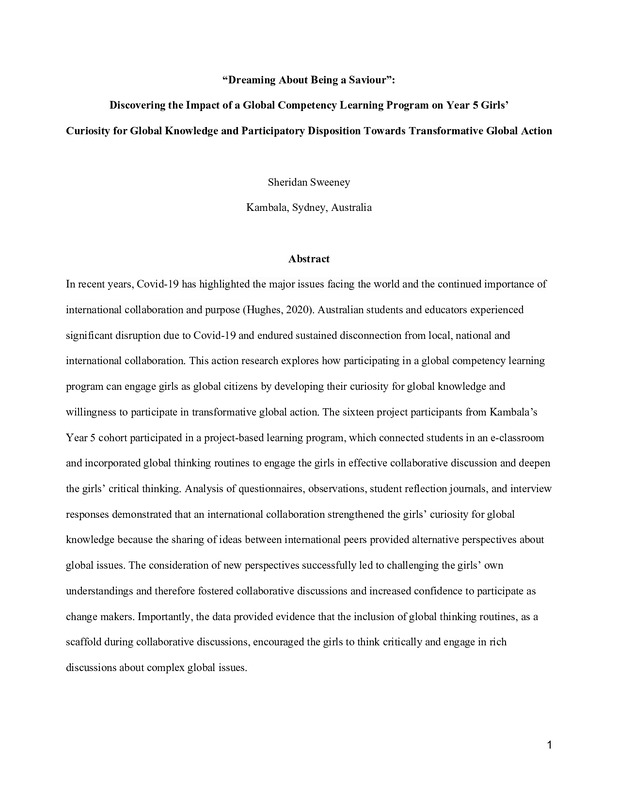 “Dreaming About Being a Saviour”: Discovering the Impact of a Global Competency Learning Program on Year 5 Girls’ Curiosity for Global Knowledge and Participatory Disposition Towards Transformative Global ActionSheridan Sweeney 2023In recent years, Covid-19 has highlighted the major issues facing the world and the continued importance of international collaboration and purpose (Hughes, 2020). Australian students and educators experienced significant disruption due to Covid-19 and endured sustained disconnection from local, national and international collaboration. This action research explores how participating in a global competency learning program can engage girls as global citizens by developing their curiosity for global knowledge and willingness to participate in transformative global action. The sixteen project participants from Kambala’s Year 5 cohort participated in a project-based learning program, which connected students in an e-classroom and incorporated global thinking routines to engage the girls in effective collaborative discussion and deepen the girls’ critical thinking. Analysis of questionnaires, observations, student reflection journals, and interview responses demonstrated that an international collaboration strengthened the girls’ curiosity for global knowledge because the sharing of ideas between international peers provided alternative perspectives about global issues. The consideration of new perspectives successfully led to challenging the girls’ own understandings and therefore fostered collaborative discussions and increased confidence to participate as change makers. Importantly, the data provided evidence that the inclusion of global thinking routines, as a scaffold during collaborative discussions, encouraged the girls to think critically and engage in rich discussions about complex global issues.
 -
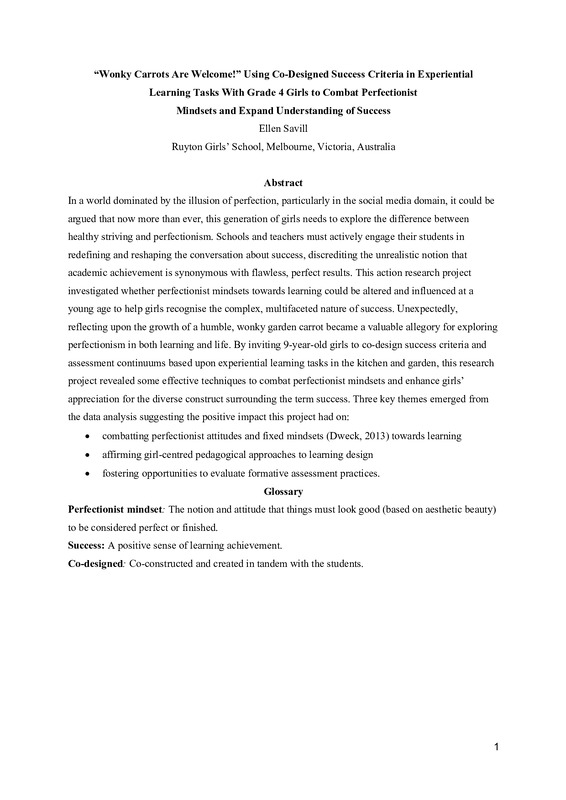 “Wonky Carrots Are Welcome!” Using Co-Designed Success Criteria in Experiential Learning Tasks With Grade 4 Girls to Combat Perfectionist Mindsets and Expand Understanding of SuccessEllen Savill (2023) 2023In a world dominated by the illusion of perfection, particularly in the social media domain, it could be argued that now more than ever, this generation of girls needs to explore the difference between healthy striving and perfectionism. Schools and teachers must actively engage their students in redefining and reshaping the conversation about success, discrediting the unrealistic notion that academic achievement is synonymous with flawless, perfect results. This action research project investigated whether perfectionist mindsets towards learning could be altered and influenced at a young age to help girls recognise the complex, multifaceted nature of success. Unexpectedly, reflecting upon the growth of a humble, wonky garden carrot became a valuable allegory for exploring perfectionism in both learning and life. By inviting 9-year-old girls to co-design success criteria and assessment continuums based upon experiential learning tasks in the kitchen and garden, this research project revealed some effective techniques to combat perfectionist mindsets and enhance girls’ appreciation for the diverse construct surrounding the term success. Three key themes emerged from the data analysis suggesting the positive impact this project had on:Ruyton Girls’ School combatting perfectionist attitudes and fixed mindsets (Dweck, 2013) towards learning affirming girl-centred pedagogical approaches to learning design fostering opportunities to evaluate formative assessment practices.
 -
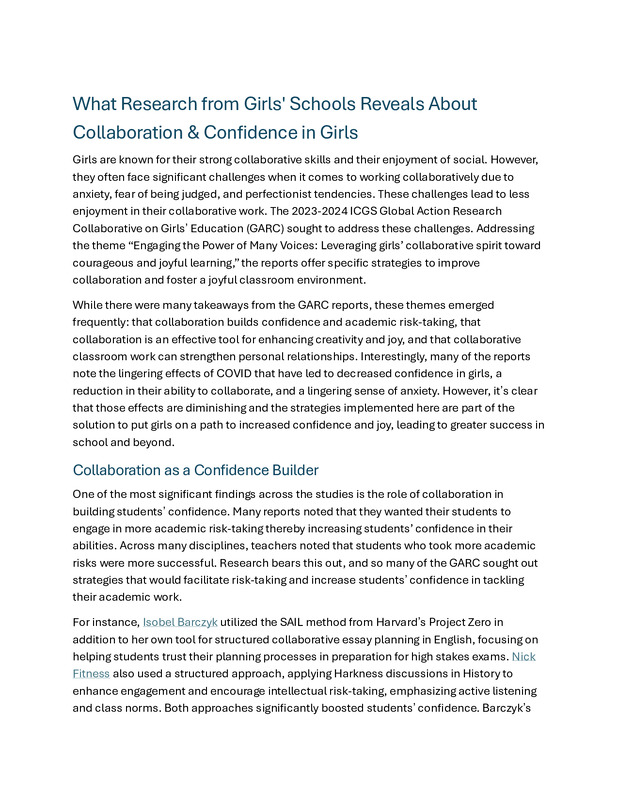 2023-24 GARC Research SummaryICGS 2024A summary of the findings of the 23-24 GARC Cohort on Collaboration
 -
Assessing the employment negotiation gender gap from the perspective of early childhood: When does the gender gap first emerge?ICGS 2025Advocates for the equality of girls and women are well aware of gender gaps in negotiation in the context of employment. Many studies have addressed this very topic, but few have considered how early childhood experiences impact this gender gap. Researchers from New York University and Boston College have explored the experiences and responses of children aged between six and 12 years to consider how this gender gap is occurring in childhood, and what this means for girls. This article provides new insight into the impact of girls’ perceptions of their own abilities when making requests, and why this shows that the employment gender gap may be first emerging during childhood. With a substantial wage gap existing between men and women in locations such as the United States, this is a challenge that still draws the attention of advocates, many industries, and researchers (Arnold et al., 2025, p. 604). Negotiation has been repeatedly identified as one of the key “drivers of wage inequity”, with women less likely than men to initiate salary negotiations, while also seeking less renumeration and benefits during negotiation processes (Arnold et al., 2025, p. 604). This is even more pronounced when women are required to negotiate with men. While much research has considered this challenge during employment negotiations, researchers have now approached this from the perspective of early childhood due to the growing occurrence of school-aged children demonstrating these same traits of girls asking for less than boys, especially when negotiating with a man (Arnold et al., 2025, p. 605). This article is based on a project that incorporated three studies involving both hypothetical and actual negotiations for tangible items with adults previously unknown to the children. The authors identified five key perceptions in children that can contribute to this widening gender gap as early as elementary school. Current understandings of adult differences in negotiation often focus on anticipated backlash, however, this study showed that in children, this is less pronounced. Instead, there is more focus on self-perceptions of “how competent children think they are at the activity for which they are negotiating” (Arnold et al., 2025, p. 618). The researchers found that boys and girls have “similar perceptions of hypothetical and actual negotiations” (Arnold et al., 2025, p. 618). Yet girls asked for less than boys during negotiations. This led the authors to ask why this is occurring. In order to investigate this question, the project was based around five key themes. The first of these were descriptive norms (recognising that girls and boys have different beliefs about what their genders typically do during negotiations) and prescriptive norms (where boys and girls hold different beliefs about what is permissible for each gender to actually do during negotiations). This was followed by anticipated social backlash (where children anticipate a negative reaction from the other negotiating party), expected utility (where children have different perceptions of expected success or gain from negotiation) and competence self-perception. This final theme was significant, because it was apparent in the project that girls may negotiate for less because they have lower optimism about their competence. The researchers found the impact of gender itself surprising. At this age, gender was not a key influence on girls’ perceptions of negotiation. There was little difference in boys’ and girls’ perceptions of how permissible it was to negotiate, and if these negotiations would be successful. There was also little impact on these perceptions based on whether the children were negotiating with a man or woman. The authors noted it was surprising to observe that there was a substantial disconnect between girls’ behaviour and what they thought other children asked for, if they thought it was permissible to negotiate, if they anticipated backlash, and if they expected the negotiation to be successful. Given these themes do exist in older age groups, further research is needed to understand at what point this aspect of gender begins to influence negotiation experiences. What did emerge from the study as a key influence for girls that contributed to a gender gap in behaviour was their self-perceptions of competence. Despite similar perceptions of negotiation itself, “the ways in which these perceptions related to how [children] negotiated differed based on their gender” and was most pronounced in practical scenarios (Arnold et al., 2025, p. 619). Girls in the study were more likely to downgrade perceptions of their competence and consequently, negotiated for less than their male counterparts. Ultimately, the researchers felt the data suggested that “girls’ behavior is more closely tied to what they think they deserve, not any perceptions of the negotiation process or the person they are negotiating with” (Arnold et al., 2025, p. 619, emphasis in o
-
 Can STEM outreach activities help address gaps in the STEM pipeline? Exploring an Irish primary school case studyICGS 2025A new case study based on primary school girls’ attitudes towards STEM in Ireland takes important steps in considering ways to address disengagement and loss of interest in STEM. Researchers from the University of Limerick and University of Galway have developed this article to respond to the gap in the STEM “pipeline”, which has become a well-recognised source of a “lack of participation, progression, and achievement in STEM education for females” (Johnson et al., 2025, p. 221). Previous research based on these gaps and possible interventions have often focussed on “only one or two STEM disciplines” (Johnson et al., 2025, p. 221). This article goes further to consider all four disciplines through a case study of a STEM outreach activity and its impact on Irish primary school girls’ attitudes towards STEM (Johnson et al., 2025, p. 221). The article discusses “STEM outreach”, which is used to “classify activities that are delivered ‘outside of the traditional student/teacher relationship to STEM stakeholders (students, parents, teachers…) in order to support and increase the understanding, awareness and interest in STEM disciplines’” (Johnson et al., 2025, p. 224). This case study is based on the Spaceship earth project, a project run between the University of Galway, University of Limerick and the Irish meteorological service Met Éireann. The project engaged students in real-world, project-based experiments in the classroom with the intention of engaging and educating teachers, students and the public about STEM. Students developed their own experiments that involved “launching high-altitude balloons to the edge of space”, before analysing and reporting on their experiment (Johnson et al., 2025, pp. 224-225). It also included workshops for students where they could explore STEM project ideas. While multiple schools were initially involved in the project, due to withdrawal from various aspects of the research, the case study is based on one all-girls school located in the west of Ireland. Fifty-one students from the school participated in the study, all aged between nine and ten years. Due to pandemic restrictions at the time, some parts of the project were converted to run online, which included the workshops. The research also involved pre- and post-project surveys to better understand the impact of the outreach activity on girls’ attitudes. Before participating, the researchers observed that all girls had a positive attitude generally towards STEM. However, the age of the students in the study is consistent with the stage where this attitude has been shown to change. After participating in the project, there was no significant change in these attitudes. This was viewed as an “encouraging result” due to the presence of positive attitudes prior to participation, and continuation of these results, especially in light of a typical negative change at this point in time (Johnson et al., 2025, p. 230). Despite this outcome, the authors noted a particular concern regarding a decline in girls’ attitudes specifically towards science as a STEM discipline over the course of the study. This reflects some similarities to other research. While this outcome is not specific to this study, it highlights the need to consider specific STEM subjects, including attitudes and required interventions, in addition to STEM itself as a broader study area. While a relatively small study, these outcomes are important for schools and educators, as they show the potential benefits of a STEM outreach activity on girls’ attitudes towards STEM generally. This is especially worthy of consideration given that the girls who participated in this project retained their positive attitudes toward STEM at a time when research shows this typically declines. While the authors note that a larger-scale project could provide additional insight into this finding, this is a useful outcome for schools to consider when planning interventions for girls. Until further research is forthcoming, the authors additionally suggest that between the ages of ten and 14 these outcomes and attitudes are nonetheless monitored closely due to the risk factors of declining positivity towards STEM (Johnson et al., 2025, p. 229). The researchers also suggest that educators and school leaders consider how outreach activities intersect with the traditional school curriculum. Rather than assuming that each operates in isolation, this provides a space to consider how these different activities interact as part of a broader approach. A key challenge identified in the project is the specific decline in positive attitudes towards science , even as overall STEM attitudes remained stable. One way to address the decline in specific STEM subjects (rather than STEM overall) is to ensure learning is “more evenly distributed across each of the STEM disciplines” (Johnson et al., 2025, p. 231). This highlights a need to enhance girls’ proficiency in each subject in order to e
 -
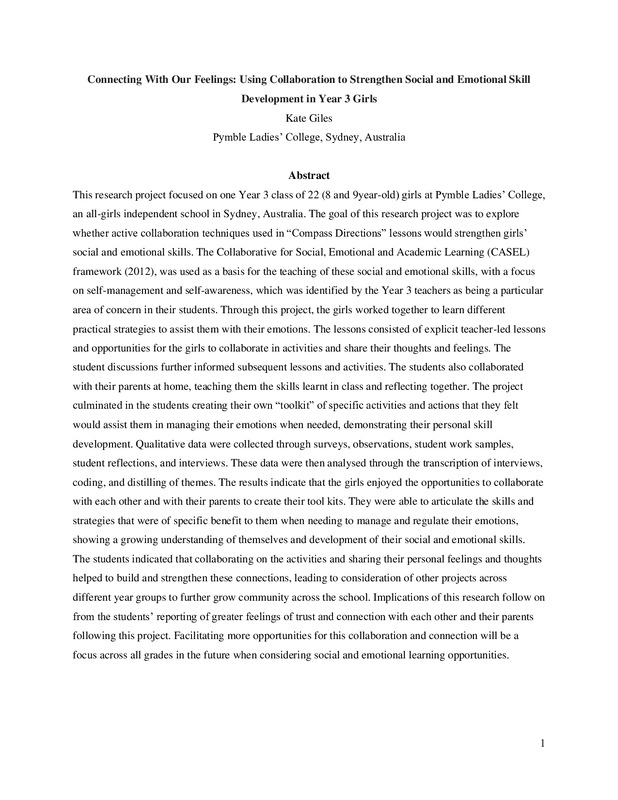 Connecting With Our Feelings: Using Collaboration to Strengthen Social and Emotional Skill Development in Year 3 GirlsKate Giles (2024) 2024This research project focused on one Year 3 class of 22 (8 and 9year-old) girls at Pymble Ladies’ College, an all-girls independent school in Sydney, Australia. The goal of this research project was to explore whether active collaboration techniques used in “Compass Directions” lessons would strengthen girls’ social and emotional skills. The Collaborative for Social, Emotional and Academic Learning (CASEL) framework (2012), was used as a basis for the teaching of these social and emotional skills, with a focus on self-management and self-awareness, which was identified by the Year 3 teachers as being a particular area of concern in their students. Through this project, the girls worked together to learn different practical strategies to assist them with their emotions. The lessons consisted of explicit teacher-led lessons and opportunities for the girls to collaborate in activities and share their thoughts and feelings. The student discussions further informed subsequent lessons and activities. The students also collaborated with their parents at home, teaching them the skills learnt in class and reflecting together. The project culminated in the students creating their own “toolkit” of specific activities and actions that they felt would assist them in managing their emotions when needed, demonstrating their personal skill development. Qualitative data were collected through surveys, observations, student work samples, student reflections, and interviews. These data were then analysed through the transcription of interviews, coding, and distilling of themes. The results indicate that the girls enjoyed the opportunities to collaborate with each other and with their parents to create their tool kits. They were able to articulate the skills and strategies that were of specific benefit to them when needing to manage and regulate their emotions, showing a growing understanding of themselves and development of their social and emotional skills. The students indicated that collaborating on the activities and sharing their personal feelings and thoughts helped to build and strengthen these connections, leading to consideration of other projects across different year groups to further grow community across the school. Implications of this research follow on from the students’ reporting of greater feelings of trust and connection with each other and their parents following this project. Facilitating more opportunities for this collaboration and connection will be a focus across all grades in the future when considering social and emotional learning opportunities.
 -
 Facilitating Ownership in Social-Emotional Learning: Grade 3 Girls’ Co-Created Mindful Routines Foster Self-Regulation and Resiliency SkillsAnnMarie Zigrossi (2023) 2023This action research project explores how 7-8 year-old girls co-created mindful routines as a strategy to foster self-regulation and resiliency. This research was conducted with a group of 14 Grade 3 students at an all-girls independent school in Toronto, Canada. The project examined how students could more independently access taught mindfulness strategies when faced with challenges throughout their day. While most research in this area focuses on the beneficial outcomes of participating in mindfulness practices and the long-term positive effects on academics and social interactions, there is less information on how students can more independently access these practices in their daily lives. In this project, the girls created a well-structured mindful routine that they practised each morning and had access to throughout their day. Students exhibited a sense of ownership in creating their unique mindful routine, which led to high levels of engagement and autonomy. The students used critical thinking skills to research various mindful practices and experimented, tested, and self-reflected to discern the practices that best suited them. Data were collected while the girls participated in their individual mindful routine each morning over a six-week period. Data collected were qualitative in nature and captured by questionnaires, interviews, observations and student journals. The results indicated that the students independently accessed this tool to support them through regular daily challenges, such as working through feeling frustrated or overwhelmed, resolving conflicts with peers at recess, and managing anxiety at competitive sporting events. The girls articulated the positive impact of using their mindful routine and how they plan to use this tool in the future. These mindful routines were used as a tool for self-regulation and demonstrated the development of resiliency skills that students can access throughout their lives to enhance their well-being. Facilitating young students’ creation of mindful routines to develop these skills and recognize their immediate positive impact will be key in the school’s future planning of Social-Emotional Learning (SEL). By AnnMarie Zigrossi
 -
Gender norms and traditional cultural understandings: Gender in the early childhood classroomGelir (2022) 2022The question of gender within the early childhood education space is one of topical importance for girls’ schools in Australia (Chapman, 2022). Australia also has an increasingly and rapidly growing body of ethnically diverse families and students, including ethnic minorities, voluntary migrants and refugees (Australian Bureau of Statistics, 2021; Australian Human Right Commission; 2014). As the author of the article notes, this research raises a number of considerations surrounding traditional gender norms, ethnic minorities and language. While the case study may have been based in a minority community in Turkey that has been subject to conflict, it does reveal the need for ongoing sensitivity to students’ ethnic backgrounds and cultural beliefs. This is particularly so in situations where ethnicity, language or other cultural beliefs do not receive formal recognition, and further highlights the ongoing impact this can have on children and families even after many years of resettlement in Australia (Stroja, 2022). The article by Iksender Gelir from the Preschool Education Department at Siirt University, Turkey, considers how Kurdish preschool children construct gender roles by drawing on household and community knowledge. Gelir’s main finding is that “children position their gender roles according to the values and expectations of their minority community” (2022, p. 302). The author identifies the development of gender roles as social constructs, noting that these gender constructs are performative, not biological. Ultimately, Gelir (2022, p. 303) highlighted the recognition that “preschool teachers need to be aware of young children[‘s] gender constructions and to challenge children[‘s] traditional gender roles by expanding definition[s] of gender roles”. The article was based on “participant observations [of two children], audio and video recordings of interactions between the teacher and children in the nursery” (Gelir, 2022, p. 302). Both children were five years of age, and experienced different languages and cultures at home compared to the preschool environment Gelir (2022). The author has based this analysis on Vygotsky’s earlier research that suggested language and the mastering of language affects children’s development of thought and intellectual growth within the context of social context and its impacts on cognition development (Vygotsky, 1978, 1986). This included the assumption that learning is both intrapersonal (i.e. cognitive) and interpersonal (i.e. social). The research for this article was conducted in Turkey, where community environments include ethnic and religious minorities. Participants in the study live in a Kurdish community located in east Turkey, and speak the Kurmanji dialect of Kurdish. The preschool was also located in the Kurdish community. This community was typically characterised by mothers undertaking housework, with fathers fulfilling “head of family” roles, and undertaking seasonal worker tasks in various Turkish cities. The region that was the focus of the study also has a higher illiteracy rate than other parts of the city. Preschool is the “first formal level of education” in Turkey, but at the time of writing is not compulsory. Children can be aged between three and five to attend preschool, which has its own dedicated curriculum. The language within preschools is Turkish, as Kurmanji is not an officially recognised language. The teacher of the preschool in the case study identified as Kurdish, and could speak (but not write) Kurmanji. There exists a perception that children of identified minority groups have a “lack of knowledge”, however, children within this demographic can indeed possess important knowledge that can facilitate learning (Gelir, 2022, p. 303). In fact, their home environments can be rich in terms of knowledge. This is important because children can transfer aspects of the home to the classroom, and the classroom to the home. This means educators need to consider the experiences of children outside of the school environment as an inherent part of the learning process. In particular, this includes a consideration of what this can contribute to the child’s experience in the classroom environment, and how their “household” knowledge is reflected within the classroom (Gelir, 2022, p. 303). The author particularly noted in the article that children can draw on their home environment to construct gender roles, but can also draw on language as part of this process. This reflects the understanding that cultural resources and household environments can “contribute to traditional gender constructions” (Gelir, 2022, p. 303). It is an “inclusive pedagogical approach” to allow students to draw on their pre-existing knowledge in learning environments, however, this simultaneously highlights the need for teachers to be aware that children’s prior experience can influence their understanding of gender constructs. In particular, Gelir (2022) observed that t