
Athletics and Sports
- Title
- Athletics and Sports
Items
-
Girls prefer single-sex PE classes & sporting activities(2024) 2024Researchers have found that mixed-sex sporting activities at school reinforce existing gender stereotypes that boys are 'better' at sport, leading to girls being discouraged from taking part. In addition, especially during adolescence when girls are highly conscious of body image and weight, they are reluctant to wear physical education (PE) uniforms or take part in PE classes and sporting activities with boys. Unsurprisingly, multiple studies find that girls prefer female-only PE classes, sports, fitness activities and outdoor education. • Mission Australia's large-scale annual survey of young people aged 15-19 revealed that students at girls’ schools obtained higher scores than the female average in the key area of physical and mental health, even during the pandemic year of 2020. More girls attending single-sex schools in 2020 reported participating in sport over the past year than the average female (75% vs 68.6%) (Mission Australia, 2020). • A study of the gendered nature of mixed-sex sailing programs for school students aged 14-18 in France and the United States concluded that “young men were viewed as being more legitimate participants and regularly took up the role of lead skipper — young women were considered secondary participants and were typically positioned as crew members” (Schmitt, Atencio & Sempé, 2020, pp. 1-2). Boys taking part in the study believed that girls were “less capable sailors” and “tried to intimidate the girls during races” (p. 9). This is consistent with previous studies which found that school sport “privileges males and often devalues female participants ” (p. 2). • A 2020 Scottish study has found that girls spend significantly more time undertaking moderate to vigorous physical activity in single-gender PE lessons. In addition, most girls enjoy and prefer single-gender Physical Education (PE) lessons for games such as basketball. The study authors suggest that segregating PE classes for game-based activities could lead to greater health benefits for girls through a higher level of physical activity (Wallace, Buchan & Sculthorpe, 2020, pp. 231). • A 2019 American study has found that PE lessons in co-educational schools “reinforce more sedentary behaviour in girls due to a more male-dominated, traditional, team-sport oriented curriculum that lacks a wide variety of choices” (p. 110). Timken, McNamee and Coste write that international research has demonstrated that co-ed physical activity and PE lessons “have been places rife with dominance, harassment, and intimidation of girls, leading girls to disengage and/or prefer different circumstances” (p. 111). Girls may prefer dance and fitness activities to traditional sports activities because they do not require a team, are non-competitive, can occur any time, and may require less coordination than team sports (p. 110). In addition, multiple studies have found that girls prefer single-gender rather than mixed gender PE classes, with two studies demonstrating that girls who participate in single-gender teams show increased competence, possibly because they perceived less competition and felt more confident about their ability level compared with the other girls (p. 111). • A UK study found that the majority of girls support separating girls and boys for sports activities . There was also stakeholder support for girls’ sports activities to be run by female coordinators who could act as role models (Morgan, Van Godwin, Darwent & Fildes, 2019, pp. 1, 4, 7). The authors’ recommendations include that co-ed schools should introduce female-only physical activity sessions that take place after school and that female role models should be used as facilitators of these activities (pp. 9-12). • Citing a 2014 study, Crystal Vargos writes that co-ed classes have been found to have a “negative effect” on girls’ participation levels in PE for multiple reasons including gender stereotypes, the teacher, the class environment, and the competitive design of PE classes. In addition, “Feelings of embarrassment, lack of confidence and self-efficacy, body image concerns, disinterest in particular activities, and dominance of males in PE” are reasons why females may dislike participating in co-ed PE classes (Vargos, 2017, pp. 1-2, citing Murphy, Diongi & Litchfield, 2014, n.p.). • A 2014 meta-analysis of 22 studies found that the largest increases in sports participation occurred in studies where interventions were based on single-sex activities . In particular, interventions that targeted girls, rather than girls and boys together, had a “higher effect size”. The study authors noted that this effect was not just present in adolescent girls who may be experiencing body image concerns, but also in younger girls. They concluded that “ongoing physical education and other structured physical activity contexts might require greater use of single sex provision” (Biddle, Braithwaite & Pearson, 2014, p. 129). • An American study examining co-
-
Play equipment in Australian children’s homes: Can we refine interventions to support girls’ engagement with physical activity? (ICGS, 2025)(2025) 2025Duncombe, S. L., Moss, K. M., Tooth, L. R., & Mielke, G. I. (2025). Sex differences in the play equipment found in Australian children’s homes. Journal of Child and Family Studies, 34 , 1283-1291. https://doi.org/10.1007/s10826-025-03037-8 . Research has shown that the different types of play equipment present in children’s homes can be associated with children’s physical activity levels. This study by researchers at the University of Queensland, Australia, investigates differences in play equipment found in Australian homes based on the gender of the child/children. The authors identify links between gender and the type of equipment present in homes, and highlight the impact of this on children’s engagement with physical activity. They suggest that early, gender-specific physical activity interventions are needed to target gender disparity in physical activity. Given the well-documented benefits of physical activity for child and adolescent wellbeing, early and positive interventions to encourage girls’ holistic participation are essential (Duncombe et al., 2025, p. 1284). This research was drawn from the “Mothers and their Children’s Health Study”, which is part of the “Australian Longitudinal Study on Women’s Health”. This included information on 5,314 children from 2,805 families, which was categorised by the number of children in the family, age, and gender makeup. This is a substantially larger study than much of the previous research published on this topic, and also considers the context of siblings in family groups. Participants were provided with a list of play equipment and asked to indicate which of the items were available to children in their homes. The list of equipment provided to participants was “balls; basketball or netball rings; bats, racquets, or golf clubs; climbing equipment or suitable trees; bicycles, tricycles, or scooters; skateboards or ripsticks; skipping ropes; swimming pools; trampolines; slides or swings; and electronic play equipment” (Duncombe et al., 2025, p. 1285). The researchers initially observed broad trends linking the gender composition of children in the household to the type of play equipment in the home. Families with all boys or mixed siblings had a higher prevalence of play equipment that included “skateboards/ripsticks, bats, racquets and golf clubs than those without a boy” (Duncombe et al., 2025, p. 1283). Families with girls or mixed siblings had a higher prevalence of play equipment in the home that included “skipping ropes, slides and swings than those without a girl” (Duncombe et al., 2025, p. 1283). Yet there were no differences observed in “balls, bicycles, trampoline, pools, or active electronic games in homes” (Duncombe et al., 2025, p. 1283). The findings were promising in relation to toys associated with active play. Previous studies have shown that toys associated with movement have typically been present in family groups with boys. Yet this study shows equal amounts of all-girl and all-boy families with toys associated with movement. This is an important finding and one that prompted the researchers to question what factors influenced this outcome (Duncombe et al., 2025, p. 1288). It indicates that providing girls with access to these types of toys could be beneficial to “augment their physical activity levels”, while maintaining awareness of how girls will use the toys, as this may differ to boys (Duncombe et al., 2025, p. 1289). These findings reinforce earlier research showing different play patterns and behaviours among girls and boys. However, it also gives a new perspective to this topic by considering the home environment and potential influence of siblings. The authors also suggest this is an opportunity to consider the role of gendered parenting and societal pressures in children’s toy preferences. This can be addressed through advocacy for “less gendered toy marketing and preschool environments”, including the promotion of gender-neutral spaces from a young age (Duncombe et al., 2025, p. 1288). Regardless of how much influence in children’s choice of play equipment can be attributed to child preference, societal norms or parent influence, the implications for physical activity levels are still crucial to understand in order to address disparities in physical activity. There was no difference between families with mixed sex siblings and all-boy/all-girl families and the types of play equipment/activity levels found in the home. This indicates that “a single child of one sex may influence the equipment in a home” (Duncombe et al., 2025, p. 1288). There was also no clear correlation between levels of physical activity with/without siblings. The number of differences in play equipment did increase as children aged, which is consistent with existing research. Preferences for gender neutral toys also decreased significantly as child age rose. This could be due to socialisation pressures and early social environments that encourage
-
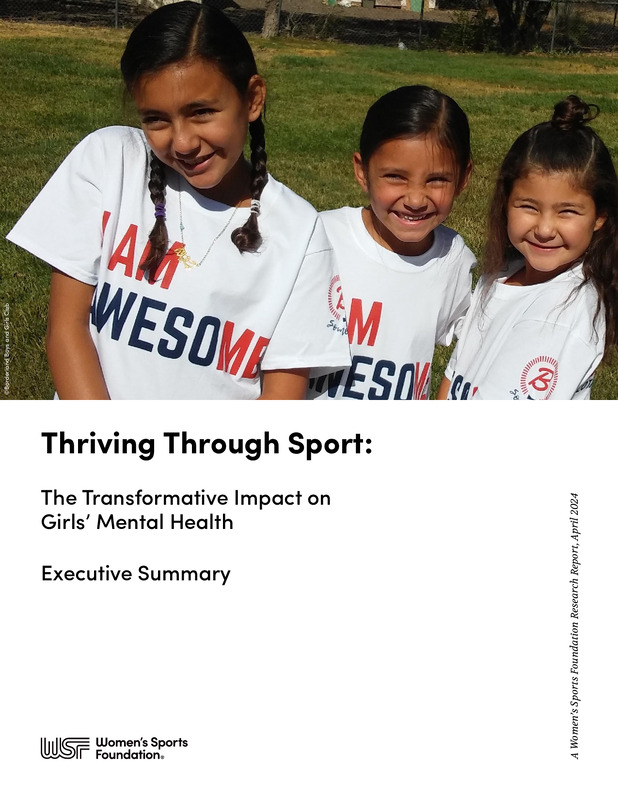 Thriving Through Sport: The Transformative Impact on Mental Health(2024) 2024Today’s youth are at an increasingly high risk of mental health disorders (Office of the Surgeon General, 2021). The ongoing mental health crisis of children and adolescents was only worsened by the confluence of issues brought about by the COVID-19 pandemic (Hiebert & Kortes-Miller, 2021) with continued growing rates of anxiety and depression as well as elevations in suicidal ideation and thoughts of self-harm among today’s youth (Reinert et al., 2021). Given the popularity and reach of sport, along with promising research on positive developmental impacts, The Women’s Sport Foundation (WSF) commissioned the Thriving Through Sport: The Transformative Impact on Girls’ Mental Health report to examine the relationship between sport participation and mental health in adolescent girls.