2024-25 GARC Research Reports: Agency
- Title
- 2024-25 GARC Research Reports: Agency
- Related Resources
-
Global Action Research Reports
- Date
- 2025
- Subject
- Agency
- Publisher
- ICGS
Items
-
Developing Agency and Leadership in Year 12 Peer Mentor Girls Through the Co-Designing and Implementation of a Social Media WorkshopLaurie Garland (2025) 2025Girls in the 21st Century often aspire to be leaders, and we need to help develop their agency and leadership skills in our education setting, to give them the tools and skills to continue into the future. At Wycombe High School, I recruited our new cohort of 20 peer mentors and met with them for 12 weeks. During this time, we discussed different themes each week to help develop the students’ leadership skills as they planned and created a social media workshop to deliver to a Year 7 class. During this process, I implemented a mixed-methods approach to collect data, including questionnaires, interviews, journals, and video recordings, and identified the themes through my analysis. The findings indicate that the peer mentors’ confidence increased when co-designing and delivering the social media workshops. The peer mentors had full autonomy and independence over the project, which strengthened their agency. The peer mentors also became more aware of their own social media practices, and the relationship between the different year groups developed, which created a sense of connectedness. The Year 12 students were able to develop a sense of agency, thereby providing them with the opportunity to strengthen their leadership skills. To further advance this study, it would be necessary to create additional opportunities within the school for peer mentors and other student leaders to exercise greater agency in their educational and school-related experiences. Listen to Laurie's podcast ( or find it on our streaming channel ): Your browser does not support the audio element.
-
Developing Self-Efficacy Through Collaboration: Building Math Confidence in Grade 6 Girls Through Academic Discussion SkillsDuncan Flaherty (2025) 2025This action research study examined the impact of academic discussion skills on developing discipline-specific self-efficacy in two Grade 6 girls’ math classes using the R.E.A.L.® discussion framework. This intervention addressed the gender confidence gap in mathematics learning, whereby girls report lower levels of math confidence than boys in their peer group (Zander et al., 2020). Research shows that cooperative learning is an effective tool for teaching mathematical problem-solving in a whole class context (Klang et al., 2021), and that combining scaffolding for discussion skills and math content can increase conceptual understanding (Kazak et al., 2015). I contended that math discussion skills provide a mechanism to increase math self-efficacy through their capacity to enable mastery experiences, vicarious experiences, social persuasion, and positive emotional states, which are the primary sources of self-efficacy (Bandura, 1997). A math-specific version of the R.E.A.L.® discussion framework, initially developed for use in humanities classes, was generated in a collaboration between R.E.A.L.® and me and piloted during the six-week action research period. The research was conducted at Nashoba Brooks School in Concord, Massachusetts, USA. The project began with a student orientation to the R.E.A.L.® discussion framework, where students learned the primary tools (relate, evidence, ask, and listen) they would use during discussions, as well as how to prepare notes for discussions and write post-discussion reflections. Collected data were primarily 2 qualitative in discussion question preparation notes, reflection notes, student journal entries, field note observations, and video recordings of discussions. Quantitative data were collected through Likert scale surveys administered throughout the intervention to measure self-reported math self-efficacy. Data were analyzed through organization, description, and interpretation using a coding process that grouped data into frequently recurring themes (Mertler, 2020). This action research study found that math-specific academic discussion skills using the R.E.A.L.® framework increased student confidence when discussing and understanding math material. Specifically, the R.E.A.L.® discussions generated evidence of growth in all four areas of self-efficacy development as outlined by Bandura (1997). The findings are significant for math educators and leaders in girls’ schools as they suggest that math-specific academic discussion skills are effective in closing the gender confidence gap in mathematics learning. Future practice should incorporate explicit teaching of discussion skills alongside other constructivist modes of instruction to maximize self-efficacy development opportunities in math classes.
-
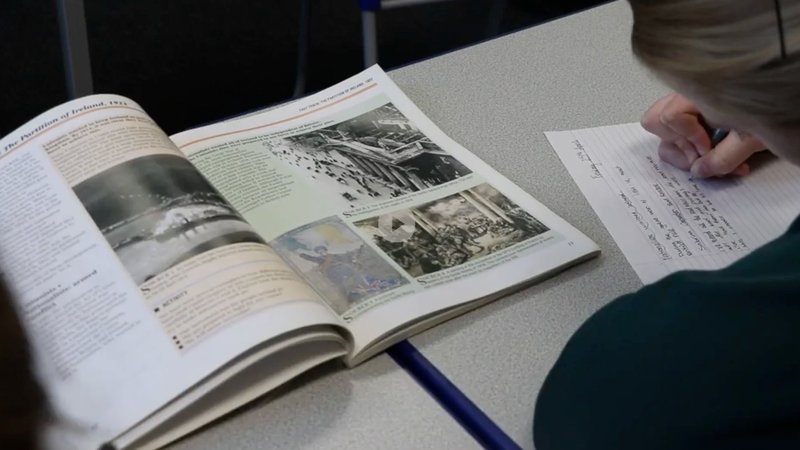
History Belongs to Us: Year 9 Girls Use Historical Significance to Craft Their CurriculumHolly Webb 2025This action research study investigated the impact of applying the skill of historical significance to meaningfully involve girls in the creation of their Year 9 history curriculum. A class of 25 girls was given explicit instruction on evaluating historical significance, and the girls were provided with multiple opportunities to evaluate the significance of the historical topics they were currently studying. The project culminated with students producing independently researched proposals for new topics they believed warranted inclusion in the school's Year 9 history curriculum, and also with the History department working with the students to implement some of these changes. Data collection techniques included questionnaires, focus groups, student work samples, and lesson observations. Thematic analysis was used to interpret the data; findings revealed that involvement in the curriculum design process and application of historical significance enhanced student agency and developed girls’ historical skills. Developing the skill of historical significance also enabled girls to distinguish between the agency of a historian and personal preferences, whilst also highlighting that comprehensive historical knowledge is crucial for students to effectively evaluate significance and exercise agency. The findings from this study are valuable for educators wanting to critically reflect on what may be considered canon in their subject or those hoping to involve students in meaningful curricular change.
-
Think, Reflect, Succeed: Using Reflective Thinking Routines to Develop Agency in Year 8 Girls in the French ClassroomTara Fennell (2025) 2025This action research project explored how 12–13 year-old girls engaged in a reflective thinking routine, which aimed at increasing their agency in French lessons. The research was conducted with a group of 14 students at an all-girls independent school in London, England. In this project, students added their questions to a physical question wall, then explored answers and related ideas together. Their discussions supported aspects such as consolidation of complex grammar, writing feedback, and topic revision. Data collected were qualitative in nature and captured by questionnaires, interviews, my field journal, lesson observations, artefacts, and student written work. The results indicated that use of a thinking routine developed individual question competence, peer questions enhanced their classmates’ learning, the question wall provided potential for stretch and challenge, and the transactional nature of the student-teacher dynamic shifted over the ten weeks of the project. The students articulated the positive impact of the project on their sense of agency and discussed how thinking routines could be used moving forward. The effectiveness of the thinking routine with other year groups and other academic subjects can next be ascertained.